The Xirkaali have some of the most dangerous charging units in Kings of War, but their best combat units aren’t necessarily their best values.
Lionsnarl Cavalry is the obvious example. At 270 points, it’s the faction’s most expensive non-character unit. My simulations suggest it earns that price when it gets the fights it wants. Nearly half of its first melee attacks result in a rout, and it wins more than 84% of simulated engagements where it charges first. Meanwhile, the units that lead my cost-effectiveness rankings are much less glamorous. Yan Warrior Monks, Brotherhood of Yan, and the Shaoquan all offer favorable returns relative to their points. That creates an interesting list-building question. How much should Xirkaali players invest in expensive, fast-moving threats, and how much should they spend on the inexpensive units that keep an army functioning?
The tournament results provide a useful reality check. Across 127 fourth-edition player observations, Xirkaali have a 47.2% result score rate. That improves slightly to 48.3% in the 4.1 records, although the sample is still small. The faction has some excellent tools, but players haven’t yet converted those advantages into consistently exceptional tournament results.
Let’s dig into the numbers.
1. The Xirkaali roster: More than fast dogs
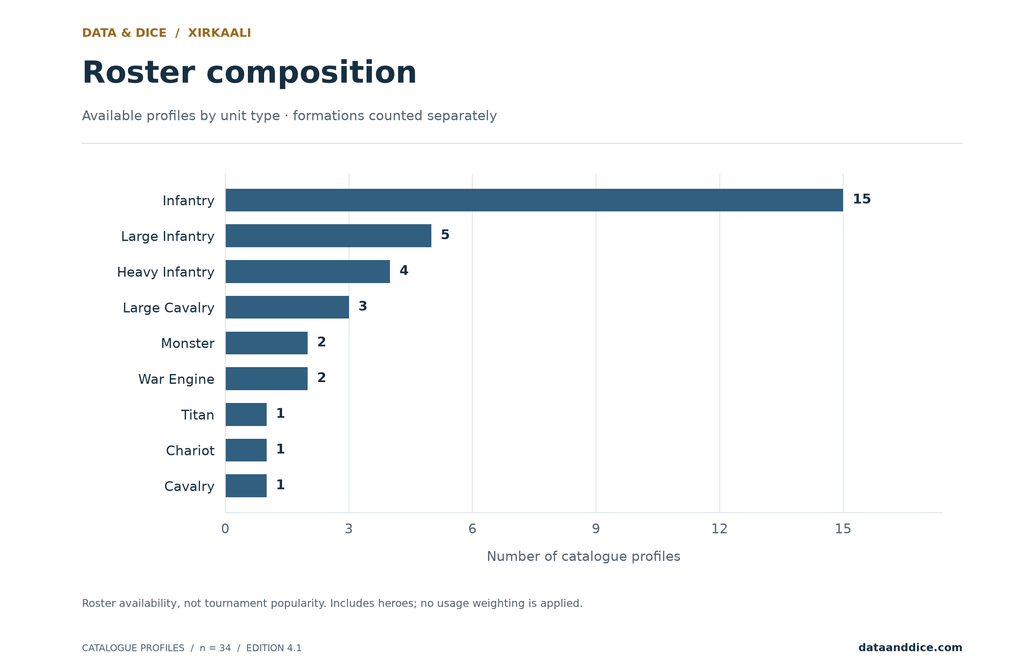
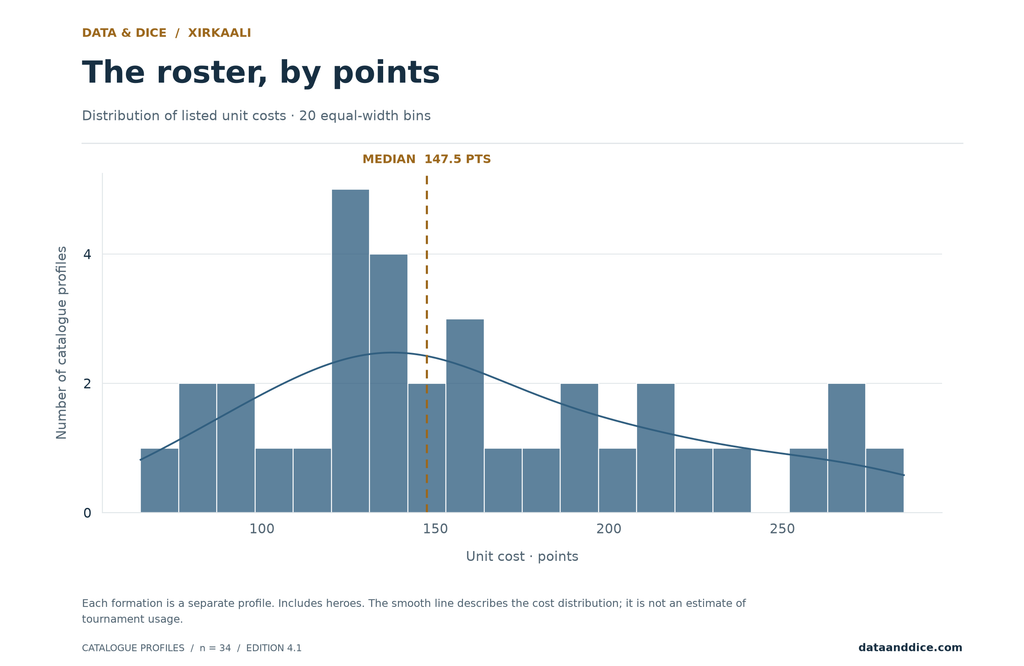
My current Kings of War 4.1 catalogue contains 34 Xirkaali profiles, including different formation sizes and 11 characters. The median listed cost is 147.5 points, and Crushing Strength is the most common special rule. Infantry accounts for 15 profiles, followed by five Large Infantry and four Heavy Infantry profiles. These counts include characters and different unit sizes, so they describe the available roster rather than a typical army.
The faction has two distinct groups of units:
Hemicyon units generally emphasize mobility and combat power. Spearwardens, Wildfangs, Warrior Packs, and Lionsnarl Cavalry give players several ways to apply pressure. Yan units tend toward slower infantry, relatively inexpensive bodies, and specialized ranged weapons. Brotherhood of Yan and Warrior Monks are particularly interesting in the simulations. The units that win fights aren’t necessarily the ones that help an army win scenarios.
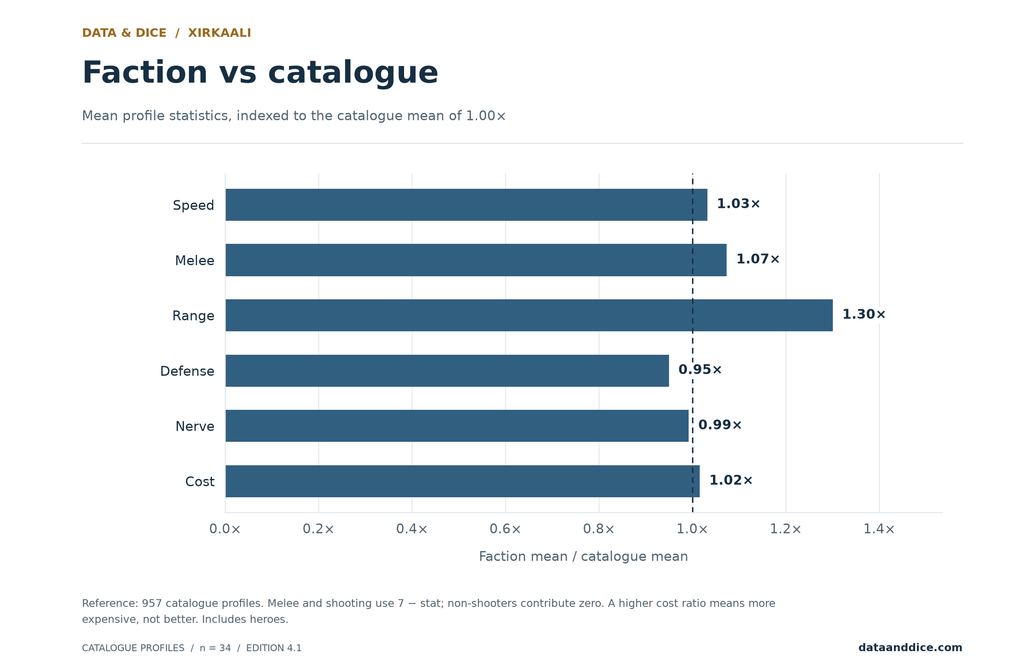
Compared with the full Kings of War catalogue, Xirkaali have slightly higher average Speed and Melee values. In theory, their indexed Range value is 1.30 times the catalogue average, although that reflects available profiles rather than actual shooting investment. In practice, tournament players have been bringing remarkably little shooting.
2. What are players actually bringing?
My Data & Dice tournament dataset provides a useful look at how the faction is performing.
Across mixed fourth-edition records (4.0 and 4.1), the dataset contains:
- 127 player-game observations from 14 events.
- 56 wins, 8 draws, and 63 losses.
- A 47.2% result score rate.
- 26 archived army lists.
The dataset awards half a win for a draw when calculating its displayed win rate.
What changes in 4.1?
Filtering to edition 4.1 leaves 59 player observations across three events. Those results are 27 wins, 3 draws, and 29 losses, producing a 48.3% result score rate. The outright win rate, without half-credit for draws, is 45.8%. That’s close to the broader fourth-edition result. The difference is too small, and the samples too limited, to establish that the faction has improved.
The 4.1 archive also contains 13 army lists. Scaled to 2,300 points, their average characteristics include:
- 13.0 units.
- 25.0 Unit Strength.
- Average Speed of 6.8.
- Average Defense of 4.2.
Nine of the 13 lists are classified as Balanced. Two are Alpha Strike, and two are Trash. That is consistent with an army built around several complementary threats rather than a single extreme approach.
The separate 30-list tournament export used elsewhere in this review covers January 24 through October 3, 2026, and contains additional composition metrics. In that sample, Xirkaali averaged just seven ranged attacks per 2,300 points, 3.2 units with Iron Resolve, and 67.2 expected damage against Defense 4+.
How did they perform at a major tournament?
The 2026 UK Clash of Kings results provide a useful individual-event comparison. Nine of the 160 entrants played Xirkaali. Across 53 reported player-game results, they recorded 25 wins, 3 draws, and 25 losses, a 50% result score rate when draws count for half. The best Xirkaali finish was Florian Kolm in 28th place with a 4-0-2 record. Matt Hobday finished 33rd, also going 4-0-2. That’s respectable, but hardly evidence of a faction dominating the field.
Taken together, the broader dataset and UK Clash of Kings tell a fairly consistent story. Xirkaali can compete, but there is little evidence yet that their best simulated units translate into an unusually high tournament win rate.
3. Where is the value?
My latest model evaluates unit efficiency using simulated combat ratings rather than simply dividing Elo by points. Elo measures relative strength in simulated one-on-one fights. I then compare each unit against a fitted baseline that accounts for its cost and formation size. The most useful resulting metric is the Points Value Ratio (PVR).
A PVR of 1.20 means the model assigns a unit an implied price 20% higher than its listed cost. It doesn’t mean the unit deals 20% more damage or has a 20% greater chance of winning.
I also use a combined cost-effectiveness score that blends standardized PVR and the unit’s Elo advantage over its expected baseline. Here are the five highest-ranked Xirkaali profiles.
| Unit | Size | Points | PVR | Combined score |
|---|---|---|---|---|
| Shaoquan | Monster | 140 | 1.27 | +1.60 |
| Yan Warrior Monks | Troop | 120 | 1.29 | +1.58 |
| Yan Warrior Monks | Regiment | 160 | 1.25 | +1.57 |
| Brotherhood of Yan | Horde | 150 | 1.10 | +0.61 |
| Spearwardens | Troop | 155 | 1.07 | +0.48 |
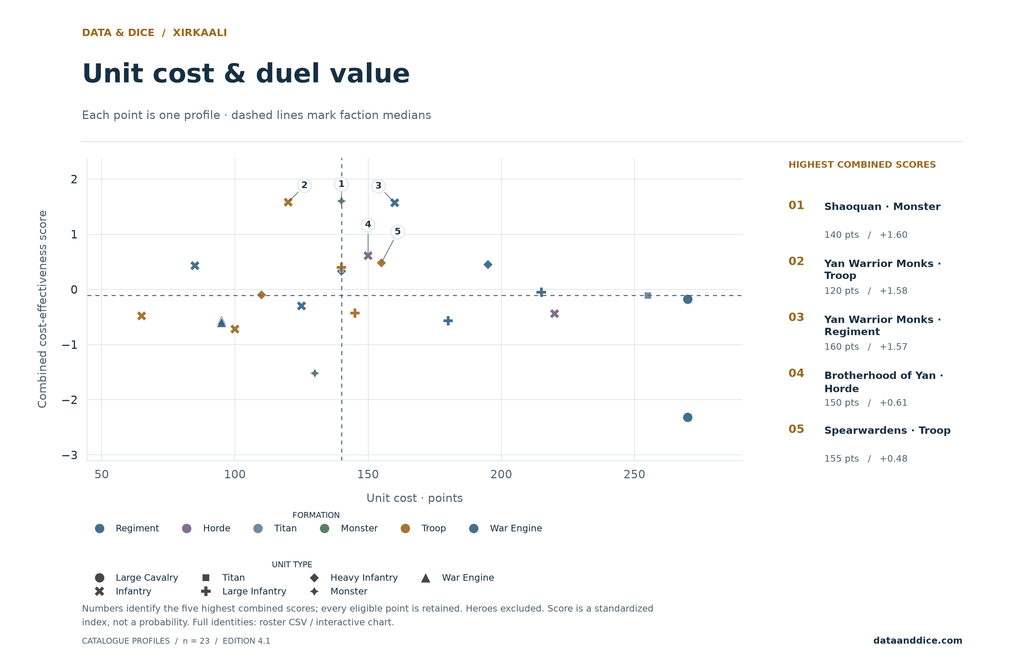
Three findings are worth discussing.
Shaoquan: Surprisingly efficient
The Shaoquan leads the faction with a PVR of 1.27. At 140 points, the model assigns it an implied value of approximately 178 points. It brings Melee 3+, Crushing Strength (2), Fearless, Iron Resolve (1), Defense 4+, and Nerve 16. Its unusual The Bigger They Are… rule can add situational value beyond the modelled results. However, its favorable cost efficiency doesn’t make it the army’s premier hammer. It routs an opponent on its first melee attack in 19.2% of relevant simulations and wins 63.8% of engagements where it charges first.
I would view it as an affordable supporting combat piece rather than the centerpiece of an offensive strategy.
Yan Warrior Monks: Excellent value at both sizes
The Warrior Monks are arguably the most interesting result. The 120-point troop has the faction’s highest PVR at 1.29, while the 160-point regiment follows closely at 1.25. The regiment offers 20 attacks hitting on 3+, Nerve 17, Ensnare, Fearless, Iron Resolve (1), and Thunderous Charge (1). That is a substantial collection of abilities for 160 points.
The drawback is Speed 5 and Defense 3+. These units are vulnerable to concentrated shooting damage and won’t dictate engagements against faster opponents. Still, their efficiency makes them attractive candidates for adding combat power without spending 200–270 points on another Hemicyon threat.
Brotherhood of Yan: Cheap Nerve and Unit Strength
The Brotherhood of Yan Horde costs 150 points and brings Nerve 24, Unit Strength 4, and Iron Resolve (1). Its Defense 3+ is a significant weakness, and 25 attacks hitting on 4+ without Crushing Strength provide limited offensive power against tougher targets. But the horde doesn’t need to destroy expensive units to justify its place. Occupying space, holding an objective, and forcing an opponent to commit resources to removing it can all contribute to winning a game. At 150 points, it also leaves considerably more room for the expensive units elsewhere in the army.
4. Hammers and anvils: Who wins the fight?
Cost efficiency tells us something about value, but it doesn’t explain how individual units behave on the table. For that, I looked at two combat measures:
- First-melee rout rate: The percentage of simulated fights in which a unit routs its opponent on its first resolved melee attack, among fights where it makes at least one melee attack.
- First-charge win rate: How often the unit eventually wins a simulated fight when it lands the first charge.
| Unit | Points | First-melee rout rate | Win rate after first charge | Avg. game rounds to win / lose |
|---|---|---|---|---|
| Lionsnarl Cavalry Regiment | 270 | 47.1% (19,295 trials) | 84.4% (14,077 trials) | 2.49 / 2.75 |
| Wildfangs Regiment | 215 | 29.4% (18,698 trials) | 73.1% (13,535 trials) | 2.92 / 3.06 |
| Yan Warrior Monks Regiment | 160 | 27.1% (19,307 trials) | 73.8% (9,734 trials) | 3.62 / 3.79 |
| Spearwardens Regiment | 195 | 21.4% (19,346 trials) | 71.2% (11,618 trials) | 3.24 / 3.43 |
| Brotherhood of Yan Horde | 150 | 19.7% (19,682 trials) | 73.0% (9,434 trials) | 3.90 / 4.42 |
The last column shows average game rounds to victory and average game rounds survived in losing fights. These are not counts of melee exchanges or measures of survival against an enemy’s initial charge.
Lionsnarl Cavalry: The premium hammer
At 270 points, Lionsnarl Cavalry delivers Speed 9, Melee 3+, 20 attacks, Defense 5+, Nerve 18, Crushing Strength (1), Thunderous Charge (2), and Vicious (Combat). Its first-melee rout rate of 47.1% is easily the best among these candidates. It also wins 84.4% of simulations in which it charges first. When it wins, the fight lasts an average of just 2.49 game rounds.
The model leaves little doubt that Lionsnarls are dangerous. However, their PVR is only 0.98, suggesting their impressive combat performance is already reflected in the 270-point price. They are also only Unit Strength 2. Destroying an expensive enemy can be a great trade, but killing something cheap before getting countercharged can be disastrous. The challenge is making sure their victories matter.
Wildfangs: The flexible threat
Wildfangs regiments cost 215 points for Speed 7, 24 attacks hitting on 4+, Crushing Strength (1), Nimble, Strider, and Wild Charge (D3). Their first-melee rout rate is 29.4%, with a 73.1% eventual win rate when they charge first. They don’t hit as reliably as Lionsnarls, but their movement rules and lower cost suggest a different role.
I see Wildfangs as potential second-wave threats, useful for exploiting gaps or punishing opponents who concentrate too heavily on stopping the cavalry. The limitation is Defense 4+ and Nerve 18. At 215 points, losing one in a poor engagement still hurts.
Spearwardens: The versatile frontline
The Spearwarden Regiment is probably the faction’s most interesting all-round unit. For 195 points, it combines Speed 7, Defense 5+, Nerve 17, 15 attacks hitting on 3+, Crushing Strength (1), Strider, and Phalanx. It isn’t the strongest hammer or the toughest anvil. But it can threaten space, absorb punishment, and fight back. My model gives it a PVR of 1.06, a modestly favorable result.
Tournament players clearly appreciate its versatility. Eight of nine Xirkaali entrants at UK Clash of Kings brought Spearwardens, as documented in my pre-tournament analysis. That level of agreement doesn’t prove the unit is underpriced, but it suggests Spearwardens are an important part of the competitive Xirkaali toolkit.
Brotherhood of Yan: An alternative anvil
The Brotherhood Horde takes almost the opposite approach. Its Defense 3+ is poor, but Nerve 24, Iron Resolve (1), and Unit Strength 4 make it an interesting objective holder. In simulated fights it lost, it survived an average of 4.42 game rounds. That’s longer than the other units in the comparison, although some of that reflects engagements where the horde simply loses slowly.
The attraction is its combination of staying power and cost. For players looking to preserve Unit Strength while investing heavily in fast combat pieces, Brotherhood of Yan deserves serious consideration.
5. The support pieces complicate the math
One of the limitations of my simulator is that it doesn’t fully capture support abilities, army synergies, command orders, and scenario play. This matters a lot for Xirkaali.
The Witch Cage, for example, receives a PVR of just 0.73. Its five attacks, Defense 4+, and Nerve 14 aren’t particularly impressive. But it also carries a Spellward aura, Arcane Silence, and Spellsteal. Those abilities can matter considerably more against some opponents than others. A poor duel score doesn’t establish that Witch Cages are poor support choices.
The same problem applies to characters, which currently don’t receive simulated Elo ratings. The Matriarch provides Very Inspiring, Pack Leader, and a Vicious (Combat) aura for Hemicyon units. The Beastmaster brings a Beast-only Strider aura for just 80 points, although its Yielding rule creates risk. The Yan Lieutenant offers Speed 8, Very Inspiring, and Iron Resolve (1). Those are potentially important tools for making the army function as a coordinated force.
The bow-equipped Lionsnarl Cavalry illustrates another limitation. It costs the same 270 points as the ordinary regiment but trades considerable melee power for ranged attacks. Its PVR falls to 0.72, compared with 0.98 for the standard unit. The simulator strongly prefers the standard Lionsnarl. That makes sense in a duel, but it doesn’t establish whether the bow version’s different engagement options have value in a specific army.
My general approach would be to use the ratings to identify promising combat units, then evaluate support and utility pieces according to the jobs they need to perform.
6. What kind of Xirkaali army makes sense?
Based on the available evidence, two approaches seem particularly interesting.
Fast combined-arms pressure
This is closest to the recognizable core from UK Clash of Kings. The army would emphasize Spearwardens for frontline pressure and scenario presence, Lionsnarl Cavalry as the primary hammer, and Wildfangs or Warrior Packs to create additional threats. Supporting characters would help keep the Hemicyon units effective, while a smaller Yan contingent provides additional bodies and Unit Strength.
The goal is to create several dangerous engagements without sacrificing the ability to score. The main risk is coordination. Fast units can outrun their support, and losing an expensive hammer in an unfavorable trade can undermine the entire plan. I would be particularly interested in whether this style consistently dictates where important fights happen or whether opponents can force inefficient trades.
Yan-centered grind and counterpunch
The second approach would lean more heavily into the faction’s efficient infantry. Brotherhood of Yan hordes provide inexpensive Nerve and Unit Strength. Warrior Monk regiments offer relatively cheap melee threats. Spearwardens reinforce the frontline, while a smaller number of faster units handle countercharges and flanking opportunities. The theoretical advantage is straightforward: more points are invested in units with favorable simulated value. The weakness is mobility and Defense. An army built too heavily around Speed 5, Defense 3+ infantry may struggle against faster opponents or sustained damage.
The live tournament archive offers some support for testing balanced approaches: nine of the 13 recorded 4.1 lists are classified as Balanced. But that classification doesn’t tell us which individual units caused a list to perform well.
Both approaches remain hypotheses rather than proven competitive recipes. Fourth-edition Battalion construction and faction-specific restrictions also need to be considered when turning them into legal lists. (Mantic explains the general structure in its fourth-edition army-building guide).
What about shooting?
Xirkaali have options. Chakrams, Plainstalkers, the Khon-Bukhan Mortar, and the Hwathca offer different ways to threaten opponents at range. But the duel results are not particularly favorable for these profiles, and the larger historical list sample shows very limited investment in shooting. That doesn’t rule out a dedicated ranged build. It simply means the current evidence is much stronger for combined-arms approaches.
Verdict: Good tools, demanding decisions
The Xirkaali have an interesting collection of strengths: Lionsnarl Cavalry is a genuinely dangerous hammer. Spearwardens combine speed, durability, and respectable offense. Yan Warrior Monks offer some of the faction’s best points efficiency, while Brotherhood of Yan provides inexpensive Nerve and Unit Strength. The weaknesses are equally clear. Much of the Yan infantry is slow and lightly armored. The strongest Hemicyon threats are expensive. And several support pieces depend on abilities the simulator doesn’t fully capture. The tournament results reinforce those tradeoffs. Xirkaali have a 47.2% result score rate across the available fourth-edition observations, rising slightly to 48.3% in the smaller 4.1 sample. Those numbers suggest a competitive faction with room to improve, rather than one that has clearly solved the edition.
My takeaway is that Xirkaali appear strongest when their expensive mobility is supported by inexpensive, efficient units that can survive and score.
The Lionsnarls can win fights. The challenge is building an army that wins the game around them. For players experimenting with Xirkaali, I’d start by testing the balance between Spearwardens, Warrior Monks, and Lionsnarl Cavalry. That seems a more productive approach than simply selecting the highest-rated units.
The next question I’d like the tournament data to answer is whether Xirkaali players who invest more heavily in Yan infantry outperform those who prioritize Hemicyon hammers. We have enough evidence to form the hypothesis. We don’t yet have enough verified results to settle it.
Further listening and reading
A few useful fourth-edition resources offer perspectives beyond my simulations.
- 26-31: Xirkaali Review — Who Let the Dogs Out? — Nerve Check, October 27, 2026. Ben, Jon, and Ray present several different 2,300-point Xirkaali approaches, including combined arms and aggressive builds.
- 858 — Xirkaali Army Review — Counter Charge, July 15, 2026. A fourth-edition episode devoted to the faction.
- Xirkaali in KoW 4 — Tier and Analysis — Kroniki Kampanii, September 28, 2026. A detailed review of individual units, army-building ideas, and tournament lists.
- Kings of War 101: Choosing an Army — Honest 4s, July 23, 2026. Includes an interesting discussion of Xirkaali’s learning curve and the importance of positioning and synergies.
You can also explore the Data & Dice tournament dataset for additional fourth-edition results.
The calculations in this review use Kings of War 4.1 profiles and saved combat simulations. They measure relative duel performance rather than complete tabletop outcomes. Scenarios, support abilities, movement, and player decisions can all change the result.
Discover more from Data & Dice
Subscribe to get the latest posts sent to your email.