The 2026 French Masters gives us a useful opportunity to compare what competitive Kings of War players were bringing in 3rd Edition with what they’re bringing now. Both the 2024 and 2026 events have 23 players competing at 2,300 points. The 2024 tournament was played under 3rd Edition, while this year’s event uses 4th Edition. That gives us a reasonably consistent starting point for looking at how list construction has changed.
And some of those changes are substantial.
Average ranged attacks have fallen by 51%. Expected melee damage is up about 13%. Players are spending more points on magic items, and several returning competitors have moved to entirely different factions. Perhaps most interestingly, the 2026 field includes two Goblin armies that approach the game in almost opposite ways. Let’s take a look at the lists and five things I’ll be watching when the tournament gets underway.
TL;DR
The 2026 French Masters field has significantly less shooting than its 2024 counterpart, although seven of the 23 armies are still classified as Gun Lines. Goblins provide the most interesting list-building contrast, with one player bringing 27 units and considerable shooting while another relies on ten Fleabag Rider regiments and an exceptional charge threat range. Returning players are also adapting in different ways, and magic item choices have become noticeably more concentrated.
Lists are available here. If you just want the spreadsheet, find it here:
The French Masters field
The 2026 tournament features 14 factions across 23 players (actually 24, but one submitted a png list, and I can’t be bothered to manually recreate it). Nine factions have exactly two representatives, and the remaining five have one each. No faction has more than two players. That’s a reasonably diverse field, particularly given the faction consolidation that accompanied 4th Edition. Interestingly, the faction Herfindahl-Hirschman Index (HHI), which measures how concentrated the field is, is essentially unchanged from 2024 at 775. The two tournaments have different faction distributions, but neither is particularly dominated by a handful of armies. The more significant differences appear when we look at how those armies are built:
| Metric | 2024 (3E) | 2026 (4E) | Change |
|---|---|---|---|
| Lists | 23 | 23 | — |
| Factions | 15 | 14 | −1 |
| Average units | 14.7 | 14.6 | ~0% |
| Average Unit Strength | 23.0 | 26.5 | +15% |
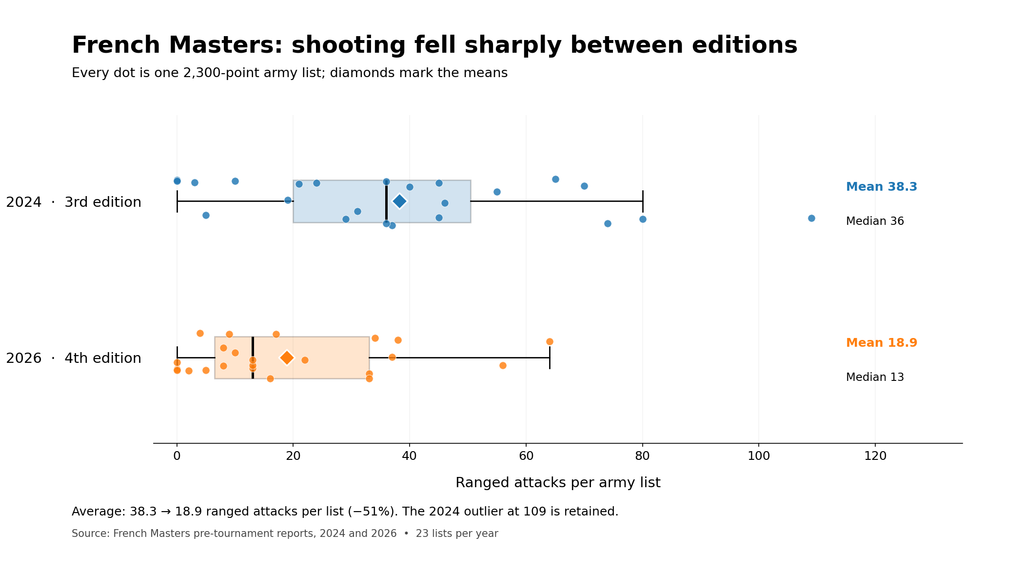
| Average ranged attacks | 38.3 | 18.9 | −51% |
| Average total attacks | 154.7 | 177.5 | +15% |
| Average expected damage | 63.3 | 71.8 | +13% |
| Average magic item points | 45.7 | 69.6 | +52% |
The shooting and combat numbers stand out immediately. Armies have roughly the same number of units, but their offensive profiles have shifted toward melee. The Unit Strength increase is also interesting, although changes in unit profiles and edition rules complicate that comparison. A caution before going further: these are two tournament fields under different editions. Some of the changes reflect new rules, new army-building incentives, and changes to the available units. This is a comparison of what players are bringing, not proof that a particular rule caused a particular outcome.
1. Shooting has fallen sharply, but seven gunlines remain
I’ve written previously about the decline of shooting in Kings of War 4th Edition. The broader tournament data showed that ranged attacks were becoming less common, even though dedicated shooting armies remained viable. The French Masters looks consistent with that trend. In 2024, the average list brought 38.3 ranged attacks. This year, that number is just 18.9. The median is arguably more revealing. It fell from 36 to 13. In 2024, ten armies brought at least 40 ranged attacks. In 2026, only two meet that threshold. Shooting is much less common in the typical French Masters army. At the same time, seven of the 23 lists are classified as Gun Lines, representing 30.4% of the field.
| Player | Faction | Ranged attacks |
|---|---|---|
| MyNickname | Goblins | 64 |
| BRG | Nightstalkers | 56 |
| Nayko | Ratkin | 38 |
| Chapelier | Salamanders | 37 |
| Ch1ps | Northern Alliance | 34 |
| Lucius | Salamanders | 33 |
| Maximork | Elves | 33 |
These seven armies account for 295 of the tournament’s 435 ranged attacks, or approximately 68% of the field’s shooting. Players appear to be making more deliberate decisions about shooting. Most armies have relatively little ranged output, while a smaller group invests enough to make it part of their game plan. We saw something similar at the 2026 US Masters, where Gun Line lists accounted for a disproportionate share of ranged attacks. The question for the French Masters is whether those seven shooting armies can consistently generate enough value before opposing melee units close the distance. I would also watch their scenario performance. A list with strong shooting can still struggle if it cannot preserve enough scoring presence late in the game.
2. Two Goblin armies with very different plans
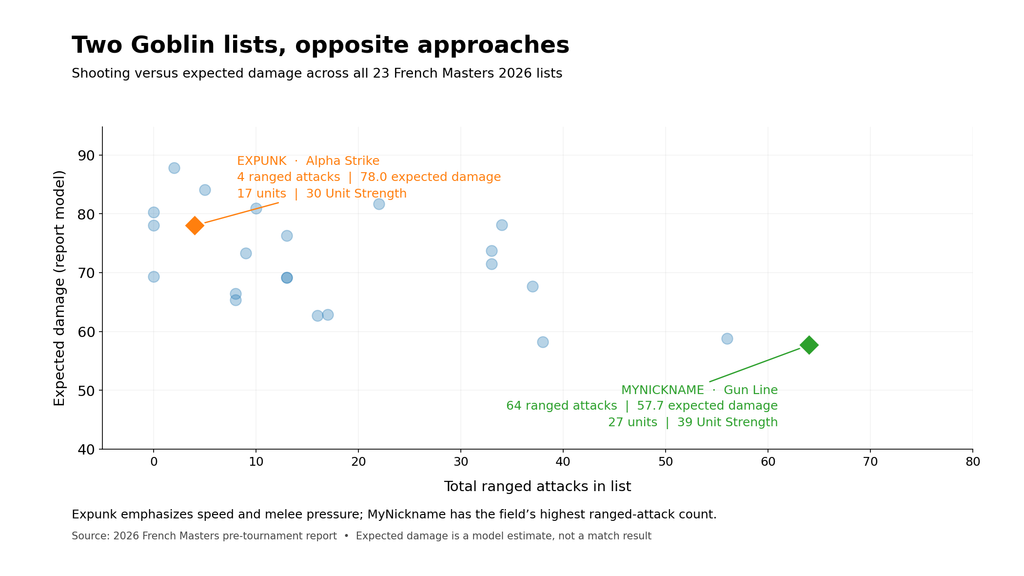
Goblins are one of the factions I’m most interested in watching, largely because of how differently the two players have built their armies. Expunk has brought a fast alpha-strike list. MyNickname has brought a 27-unit gunline. The contrast is substantial.
| Metric | Expunk | MyNickname |
|---|---|---|
| Archetype | Alpha Strike | Gun Line |
| Total units | 17 | 27 |
| Unit Strength | 30 | 39 |
| Ranged attacks | 4 | 64 |
| Expected damage | 78.0 | 57.7 |
| Nerve pool | 236 | 328 |
| Average speed | 8.4 | 6.0 |
| Damage-weighted threat range | 18.9″ | 12.2″ |
Expunk: Ten Fleabag Rider regiments
Expunk’s list includes ten Fleabag Rider regiments, three Mawbeast Packs, a Rabble horde, and supporting characters. The army has almost no shooting. It is built around speed, mobility, and the ability to put pressure on the opponent very quickly. Its average speed of 8.4 is the highest in the tournament. The threat-range analysis is even more striking. Expunk has 65.5 expected damage associated with units threatening 20 inches, giving the army a damage-weighted average threat range of 18.9 inches, well ahead of the rest of the field. Of course, having that much potential damage at 20 inches does not mean it can all be delivered in one turn. Charges still require room, favorable positions, and suitable targets. Ten Fleabag Rider regiments also create practical issues around deployment and traffic management. Still, I would not enjoy giving that army an uncontested first charge. For opponents, the challenge will be managing the initial engagement without surrendering too much board position. Chaff placement and the ability to countercharge effectively could be particularly important.
MyNickname: Twenty-seven units and a lot of shooting
MyNickname takes a different approach. The list includes:
- 12 Rabble regiments
- 4 Big Rocks Throwers
- 3 War-Trombones
- 2 Mawbeast Packs
- 4 Wiz characters
- 2 Flaggit characters
That’s 27 units, 39 Unit Strength, and a nerve pool of 328. All three are the highest values in the 2026 field. The army also has 64 ranged attacks, more than any other list in the tournament. The challenge here is managing board saturation. Twenty-seven units provide a lot of opportunities to occupy space, interfere with movement, and contest objectives. The shooting adds pressure while the Goblins spread across the table. The list’s expected melee damage is considerably lower than Expunk’s, but it has more units available to absorb losses and maintain a presence on multiple parts of the battlefield. I would be interested to see how it performs against armies that can remove cheap units efficiently. Large unit counts are valuable, but only if enough of those units remain useful when the objectives are decided. These two Goblin armies should give us a useful look at two different approaches to 4th Edition list construction.
3. The threat-range gap is enormous
One of the improvements I’ve made to the Data & Dice tournament reports is a more detailed look at threat ranges. Simply counting how many units can charge 20 inches can be misleading. A single fast character may have a long threat range without representing much of an army’s actual damage output. The damage-weighted threat range addresses that by considering how much expected melee damage sits at each charge distance. Here are the five longest damage-weighted threat ranges in the 2026 French Masters field.
| Player | Faction | Damage-weighted threat range |
|---|---|---|
| Expunk | Goblins | 18.9″ |
| Julo62 | Kingdoms of Men | 16.0″ |
| Sousou | Forces of Nature | 15.7″ |
| Silence | Twilight Kin | 15.5″ |
| Orckel | Orcs | 15.2″ |
Expunk is the clear outlier. For comparison, the longest damage-weighted threat range in the 2024 report was 15.9 inches. That’s a useful comparison, although the underlying units and rules have changed. At the other end of this year’s field is Kutchuc’s Dwarf army, which has an average speed of just 4.3 and a damage-weighted threat range of 8.4 inches. He has also built one of the toughest armies at the tournament. His Dwarfs average Defense 5.6, the highest in the field, and lead the report’s Shots to Six Nerve durability measure at 737. The list includes six Ironguard regiments, two Ironguard troops, Bulwarkers, Shieldbreakers, and supporting characters. This creates an interesting matchup question:
Can a slow, durable army absorb the initial impact of the fastest armies and then win through attrition and scenario play?
Kutchuc has plenty of staying power, but he will need to manage opponents who can choose where and when to engage. Expunk has reach, but fast units that commit too aggressively can find themselves exposed to countercharges. I would be interested in seeing how the slower armies perform in scenarios that require them to control several parts of the board.
4. Familiar players are adapting to a different edition
One useful feature of having the 2024 French Masters report is that we can follow individual competitors across the edition change. I identified 12 players who appear in both the 2024 and 2026 fields. Seven of them have changed factions:
| Player | 2024 faction | 2026 faction |
|---|---|---|
| Expunk | Brothermark | Goblins |
| MyNickname | Twilight Kin | Goblins |
| BRG | Free Dwarfs | Nightstalkers |
| Kintz | Empire of Dust | Orcs |
| Knurlnien | Varangur | Elves |
| Jarekson | Order of the Green Lady | Kingdoms of Men |
| Maximork | Ratkin | Elves |
Most of these changes reflect factions that were removed or consolidated in 4th Edition. Others are new army choices. It would be difficult to determine from the lists alone whether players are switching because of competitive strength, existing miniature collections, or simply wanting to try something different. But the returning players who stayed with their factions are interesting too. Kutchuc is a good example: In 2024, his Dwarf army had 80 ranged attacks. In 2026, he has eight. The new list emphasizes durable units and grinding combat rather than shooting. Dablama has also remained with Northern Alliance while reducing ranged attacks from 74 to 22. Ketep’s Trident Realm list moved from 45 ranged attacks in 2024 to 17 in 2026. These are substantial changes in how familiar armies are being built.
Not every returning player followed that pattern. BRG, for example, moved from a Free Dwarf army with no ranged attacks in 2024 to a Nightstalker list with 56 this year. The returning-player comparison reinforces the broader observation: the French Masters field has changed substantially, but the adjustment has not been uniform. I’ll be interested to see which approaches prove successful.
5. Magic item choices have become more concentrated
The magic item data contains another interesting change. In 2024, the field used 35 different magic item types. In 2026, that number is down to 23. At the same time, average spending on magic items increased from 45.7 to 69.6 points per army. Players are investing more points while selecting from a narrower group of items. The most obvious example is Sir Jesse’s Boots of Striding. In 2024, five of the 23 lists included the Boots. This year, 13 lists have them. That’s 56.5% of the field. For anyone trying to plan around terrain and charge positioning, the popularity of the Boots is worth remembering. More than half the tournament has invested in that particular movement upgrade. The overall concentration of magic item choices has increased as well.
Using HHI, where a higher number means selections are concentrated among fewer options, the index rose from approximately 453 in 2024 to 752 in 2026. That does not establish a balance problem. Magic item availability, point costs, and rules have changed between editions. Popularity also does not tell us whether an item is generating sufficient value for its cost. But the pattern is worth tracking. If the same small group of items continues appearing across competitive events, it may suggest that players have identified a set of generally useful upgrades that fit many different armies.
An experimental look at the favorites
The latest report also includes an experimental machine-learning matchup model. The model was trained on 4.1 tournament results and estimates expected results against the other lists in the field. These scores are not calibrated win probabilities, so I would be cautious about treating them as predictions. Still, the rankings offer a few additional armies to watch. The three highest average matchup scores belong to:
| Player | Faction | Model score |
|---|---|---|
| MyNickname | Goblins | 0.756 |
| Fao | Forces of the Abyss | 0.711 |
| Knurlnien | Elves | 0.642 |
MyNickname’s Goblins appearing at the top is consistent with the army’s unusual combination of unit count, shooting, and scoring presence. Fao is also worth watching. The Forces of the Abyss list has 84.1 expected damage, making it one of the harder-hitting armies in the field, while retaining a balanced overall profile. Knurlnien brings a balanced Elven army with strong movement and 76.3 expected damage. I would use these rankings as hypotheses to test against the tournament results. The model is still experimental, and unusual lists can be especially difficult to evaluate from historical data.
What I’m watching at the French Masters
There are five questions I’ll be following when results are available.
1. Can the dedicated gunlines compete? Seven players have invested meaningfully in shooting. Their results should give us another data point on how viable that approach remains in 4th Edition.
2. Which Goblin approach performs better? Expunk’s Fleabag-heavy alpha strike and MyNickname’s 27-unit gunline represent very different strategies. Their performance should be interesting even if they never face each other.
3. Can durable armies handle the threat-range pressure? Kutchuc’s Dwarfs will be a particularly useful test of whether slow, defensive lists can withstand fast opponents and still compete on objectives.
4. How do returning players perform with their new armies? Seven returning competitors have switched factions. I want to see whether those changes translate into strong results and whether the players who stayed with familiar factions can continue competing effectively.
5. Do the popular magic item choices deliver? Sir Jesse’s Boots appear in more than half the lists. That alone doesn’t tell us whether they’re worth their points, but it gives us a useful item to track as the tournament develops.
Final thoughts
The 2026 French Masters looks quite different from the 2024 event. Shooting is down sharply, melee output is higher, and some returning players have made major changes to their armies. The Goblin lists are particularly interesting because they show how different two armies from the same faction can be. I’m generally positive about the direction of 4th Edition’s core mechanics, particularly the emphasis on positioning and making meaningful choices in combat. The French Masters lists suggest that players are finding different ways to work within those mechanics, even if some list-building patterns are becoming more concentrated.
The next step is seeing how those choices perform. I’ll revisit the field once the results are available and compare the strongest finishes against these pre-tournament expectations. One event won’t settle the balance questions, but it should give us another useful look at which approaches are working in competitive 4.1.
Discover more from Data & Dice
Subscribe to get the latest posts sent to your email.