The lists are out for the 2026 UK Clash of Kings, and I was able to parse 160 competitor lists. That gives us a pretty good look at the field before anyone rolls a die. I am less interested in trying to predict the winner from an army list. There is far too much player skill, matchup variance, scenario play, and general Kings of War nonsense involved for that. The useful question is simpler: What should we be watching when UK Clash of Kings starts?
A few things jump out. Orcs have arrived in force. Xirkaali have a meaningful presence at their first UK COK in Fourth Edition. Ratkin and Goblins bring a lot of scenario weight. Shooting is concentrated in some very specific lists. And despite only a handful of lists fitting a true alpha-strike profile, long-range combat threats are everywhere. Here is what I noticed.
The field is broad
Start with faction representation.
| Faction | Lists | Share |
|---|---|---|
| Orcs | 14 | 8.8% |
| Forces of Nature | 12 | 7.5% |
| Kingdoms of Men | 11 | 6.9% |
| Forces of the Abyss | 11 | 6.9% |
| Salamanders | 11 | 6.9% |
| Dwarfs | 10 | 6.3% |
| Nightstalkers | 9 | 5.6% |
| Ogres | 9 | 5.6% |
| Xirkaali | 9 | 5.6% |
| Undead | 8 | 5.0% |
| Halflings | 8 | 5.0% |
| Empire of Dust | 8 | 5.0% |
There is no obvious faction takeover here. Orcs are the most popular army, but 14 players in a 160-list dataset is only 8.8% of the field. The top five factions combined make up just under 37%. That should make the top tables interesting. There are enough players in the major factions to give us useful evidence, but nobody has enough representation to overwhelm the tournament just through numbers.
It also makes this a particularly useful event for judging early Fourth Edition. Smaller tournaments can swing dramatically because three or four members of the same club bring the same army. UK COK gives us a much wider sample.
1. Can Orcs turn all that damage into wins?
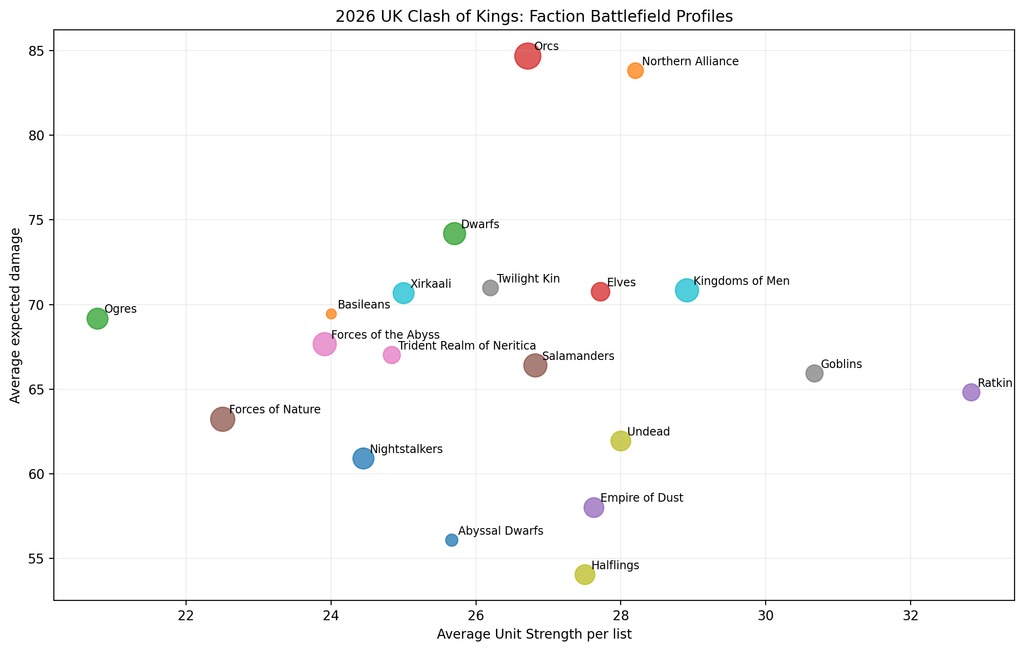
Orcs are my first faction to watch. They are the largest army in the field with 14 players, and the lists are aggressive. Across those 14 armies, Orcs have the highest average expected damage in the tournament at 84.7, well above the overall field average of 68.2. There is also a pretty recognizable Orc toolbox:
- Greatax appear in 11 of 14 lists.
- Gore Riders appear in 10.
- Godspeakers appear in 10.
- Riftforged Legionaries appear in nine.
- Helstrikers appear in nine.
That does not mean every Orc player has copied the same list. It does mean there is fairly broad agreement about where the efficient pieces are.
Alistair Oliver’s list is a good example of the approach. It brings two Greatax hordes, two Riftforged Legionary hordes, two Gore Rider regiments, and two Helstriker regiments. My model gives it 98.7 expected damage, the highest total in the field. That is an awful lot of problems to solve.
The question for Orcs will be scenario conversion. Raw combat power only gets you so far in Kings of War. If the Orc lists can preserve enough Unit Strength while trading their combat pieces, I would expect them to be a regular feature on the upper tables. If they struggle, it may tell us that raw Fourth Edition Orc efficiency is easier to contain than the list metrics suggest.
2. Xirkaali get their first big UK test
Nine Xirkaali lists is more than I expected. That ties them with Nightstalkers and Ogres and puts them ahead of several established factions. More interestingly, the army already has a recognizable core:
Eight of nine Xirkaali players bring Spearwardens.
Eight bring Lionsnarl Cavalry.
Seven bring Brotherhood of Yan, seven bring Wildfangs, and seven bring Warrior Packs.
Seven of the nine lists are classified as Balanced.
So this does not look like players wildly experimenting with a new faction. There is already a reasonably clear idea of how Xirkaali should be assembled.
Movement is the other part to watch: several Xirkaali armies sit near the top of the tournament’s threat-range analysis. Todd Durkin, Mick McKee, Chris Pudney, Heather Armstead, and Florian Kolm all have damage-weighted threat ranges around 15 inches or better. Todd’s list gives a good picture of why: Spearwardens, Wildfangs, Lionsnarl Cavalry, Brotherhood units, a Matriarch, and Witch Cages all contribute different layers of pressure. I would watch how opponents deal with that combination.
Do Xirkaali dictate where the important fights happen, or can opponents force them into inefficient trades?
We should also learn quite a bit about the internal balance of the faction. Nine players using many of the same units is enough to start separating a strong faction core from simple early-edition enthusiasm.
3. Ratkin and Goblins may win games with Unit Strength
Some of the most interesting lists in the room are not the ones with the highest damage but the ones carrying a lot of scoring power, as we saw in US Masters. Ratkin average 32.8 Unit Strength, the highest faction average in the field. Goblins come next at 30.7. Kingdoms of Men average 28.9. The tournament average is only 26.2.
That becomes important very quickly once units start disappearing. Nigel Emsen’s Goblin list is probably the clearest example. It has:
- 21 units
- 39 Unit Strength
- 270 total attacks
- four War-Trombones
- multiple Sharpsticks units
- multiple Mawbeast Packs
- two Goblin Slashers
It is going to put a lot of pieces on the table.
Jimmy Marriott’s Ratkin list also reaches 39 Unit Strength while carrying 17 units. Ratkin as a faction are especially interesting. All six Ratkin players bring both Shock Troops and Warriors, and the faction averages 213 attacks per army while maintaining all that Unit Strength.
For players preparing for these armies, killing the obvious hammer may not be enough. The practical question is what is still scoring on turns five and six. A Ratkin or Goblin player who gets to the late game with six or seven scoring units spread across the board can make a technically successful attrition game feel pretty irrelevant.
4. Shooting is concentrated rather than universal
One of the broader Fourth Edition trends has been reduced shooting investment. UK COK fits that pattern. The average list has 27 ranged attacks, down from about 32 at UK COK in 2024 and 38.5 last year. I would still bring a plan for shooting. There are 53 lists classified as Gun Line, and some of them are very committed to the idea. At the faction level:
- Halflings average 57.5 ranged attacks.
- Empire of Dust average 57.4.
- Elves average 53.7.
- Salamanders average 40.5.
- Goblins average 39.0.
- Dwarfs average 36.0.
Then there are the true outliers. Paul Bartlett’s Ogre army has 134 ranged attacks. That list includes seven Boomer regiments. Seven. Cornelia Leitner’s Elves bring 114 ranged attacks. Darek Darkowski’s Empire of Dust have 111. Sam Stones has 106 with Halflings.
So I would describe the field as having less general shooting, but some very serious specialist shooting lists. That matters for preparation. You probably do not need to build every list around surviving six turns of ranged attrition. You still need to know what happens when you draw the player who absolutely did.
5. Do not mistake “Balanced” for slow
Only four lists are classified as Alpha Strike. That sounds like a relatively sedate field. The underlying movement data says otherwise. Fly appears somewhere in 65% of lists. Strider is in 58.8%. Pathfinder is in 46.3%.
There are a lot of armies that may be classified as Balanced or Grind but still have pieces capable of reaching a long way across the table. The threat-range analysis makes that clear. Vidar Hemingway’s Goblins are the extreme example. The army has an average Speed of 9.6 and a damage-weighted threat range of 19.1 inches. The list is full of Fleabag Riders, Fleabag Rider Sniffs, Groany Snark, and other Speed 9–10 pieces.
Vincent Miller’s Kingdoms of Men are another interesting one. Three Beast Knight regiments, Knights, multiple Light Cavalry troops, and a mounted Duke produce a list with no ranged attacks but 78 expected damage and an extremely long combat footprint.
Darren Ware’s Forces of Nature use Air Elementals and a Greater Air Elemental to create similar pressure from a very different army. There are enough 18–20 inch combat threats in this tournament that deployment and screening are going to matter. A player who casually leaves a 20-inch angle open may find out very quickly that the opponent’s “Balanced” list was only balanced until it charged something important.
6. The grind armies are still here
At the other end of the spectrum, there are some armies designed to make removing them deeply unpleasant. Dwarfs are the clearest example. The ten Dwarf lists split perfectly between five Grind and five Gun Line armies, and Dwarfs have the highest average Defense in the field at 4.84. Ironguard appear in eight of the ten lists. All ten bring Berserker Brock Riders.
Forces of Nature also lean heavily toward attrition. Seven of their 12 lists are classified as Grind. Eleven of 12 players bring a Druid. Earth Elementals appear in seven lists, and Air Elementals in nine.
Empire of Dust take this in another direction. Six of their eight armies are classified as Gun Line, but all eight bring a Cursed High Priest. Seven bring an Idol of Shobik. Shambling, Heal, and Lifeleech are heavily represented across the faction.
These armies may not win by producing the biggest first charge. They can win by making the opponent spend three turns solving the same problem. That matchup becomes especially interesting against the Orc lists. UK COK should give us a good test of whether high immediate damage or long-term board durability has the stronger tournament profile right now.
7. Some support tools are almost part of the terrain
The spell and magic-item tables also give players a useful checklist.
The most common spells are:
| Spell | Appearances |
|---|---|
| Bane Chant | 82 |
| Surge | 73 |
| Heal | 56 |
| Blizzard | 33 |
| Scorched Earth | 26 |
| Lightning Bolt | 24 |
Bane Chant remains everywhere. Surge being almost as common is also a useful reminder of how many Shambling armies are in the field.
Among magic items, Sir Jesse’s Boots of Striding lead comfortably. They appear in 69 lists, or 43.1% of the entire field. Brew of Sharpness is next at 37, followed by Brew of Strength at 30. That does not make Boots mandatory. More than half the tournament is still playing without them. It does mean you should probably assume an important enemy unit can ignore terrain penalties until you confirm otherwise.
A brief note on list diversity
I have written recently about whether Fourth Edition lists are becoming more repetitive and whether players within a faction are settling onto the same basic builds. UK COK adds an interesting data point. At the tournament level, the field is very broad. Twenty faction labels are represented and no faction breaks 9%.
Within factions, the lists look more similar. About 25% of UK COK lists contain four or more copies of the same exact unit and formation size. That is above the late-Third Edition rate of 19.3%, although below the 34.1% rate in my earlier Fourth Edition sample.
The stronger signal is common faction cores. The average pair of same-faction UK lists shares about 32% of its exact unit-and-size composition. The closest same-faction neighbor averages about 52% overlap. I would not make that the main story of UK COK. It does give us something useful to watch. If those common Orc, Xirkaali, Ratkin, Trident, or Empire of Dust cores repeatedly reach the upper tables, then players may have genuinely identified the efficient chassis for those factions. If results scatter all over the place, recognizable faction identity may simply be part of a young edition settling down.
What I want to know after six rounds
Once the results come in, there are five questions I would go back to first.
1. Do Orcs convert?
Fourteen players and the highest average damage gives us enough data to see whether the faction’s raw numbers translate into strong finishes.
2. How good are Xirkaali really?
Nine lists is a meaningful first major sample. If several finish near the top, that will get my attention.
3. Does Unit Strength win games?
Ratkin, Goblins, and Kingdoms of Men give us good tests of armies built with lots of scoring presence.
4. Can the specialist gunlines survive the field?
The tournament as a whole is less shooting-heavy, which may actually create space for the players who committed hard to ranged pressure.
5. Do the common faction cores rise together?
This is probably the one I am most interested in. If multiple players from the same faction succeed with similar packages, that is much stronger evidence than one player winning with one clever list.
Main Takeaway
This is a wide-open field, and I’m interested in seeing how this all shakes out. If you spot data parsing errors, please reach out to me on the KOW Forums. With this many lists, inevitably something slipped through and was incorrectly categorized. Please let me know if you come across it so I can keep the data clean.