Which units are most likely to rout an opponent with their first melee attack? I ran the numbers on Kings of War 4.1’s biggest hitters, then checked their damage, Elo ratings, and points efficiency to see which ones deserve the hype.
Fourth Edition changed the role of combat in Kings of War. Shooting remains useful, but Mantic has been clear that it wants decisive engagements to happen in melee. The changes to shooting and sticky combat reflect that philosophy.
That makes the hammer more important than ever.
We all know what a hammer is: the unit you point at something you want removed. Ideally, it charges, does an unreasonable amount of damage, and leaves you wondering why you bothered bringing the rest of your army.
But which units actually do that best?
I went back to my combat simulator and looked at the current 4.1 unit profiles. This time, I wanted to distinguish three things:
- Burst damage: How often does a unit rout an opponent with its first melee attack (i.e. the One-Round Rout percentage)?
- Delivery: How often does it land the first charge?
- Overall value: Does that impressive first hit translate into stronger duel performance relative to the unit’s cost?
The results produced some predictable names, a few surprises, and an interesting lesson about two-handed weapons.
How I measured a hammer
The current dataset contains 957 unit profiles across 20 factions. For this analysis, I narrowed the field to 533 profiles with:
- No standard shooting attack (
Sh = 0, so leaving out dual-use units). - No individual keyword.
- At least 1,000 simulated combats in which the unit successfully made a melee attack.
- A recorded first-melee rout rate.
The main measure is first-melee rout rate: the percentage of qualifying combats in which a unit routed its opponent on its first resolved melee attack. An important distinction: a unit’s first melee attack does not necessarily happen on the first turn. My simulator starts units 36″ apart, so several rounds typically occur before melee.
I also calculated expected melee damage against Defense 4 and Defense 5 on an unhindered charge. These are baseline estimates from Attacks, Melee, Crushing Strength, and Thunderous Charge.
Finally, I checked Elo and points efficiency. Elo is a rating built from simulated duel results. A higher rating means the unit has performed better against its opponents in the model. It does not account for points cost.
For efficiency, I use Points Value Ratio (PVR), which compares a unit’s Elo with what the model expects for its price and formation size. A PVR of 1.17 means its rating maps to an implied price about 17% higher than its actual price against that fitted baseline. That does not mean it wins 17% more games, and it certainly doesn’t prove that the unit is underpriced in tournament play.
With that out of the way, let’s get to the hammers.
The five biggest opening-strike hammers
| Unit | Points | First-melee rout | First charge | Damage vs Def 4 / 5 | PVR |
|---|---|---|---|---|---|
| Ogre Warriors (2H), Horde | 275 | 61.3% | 47.5% | 16.7 / 13.3 | 1.07 |
| Order of the Abyssal Hunt, Horde | 360 | 58.5% | 70.9% | 16.7 / 16.7 | 0.86 |
| Fire Elementals (Greater Firebrand), Regiment | 205 | 51.0% | 39.9% | 8.9 / 8.9 | 1.17 |
| Frostfang Cavalry, Regiment | 265 | 48.7% | 59.9% | 12.5 / 10.0 | 0.97 |
| Ogre Warriors (2H), Regiment | 185 | 48.1% | 44.2% | 10.0 / 8.0 | 1.17 |
1. Ogre Warriors (2H): The biggest hammer
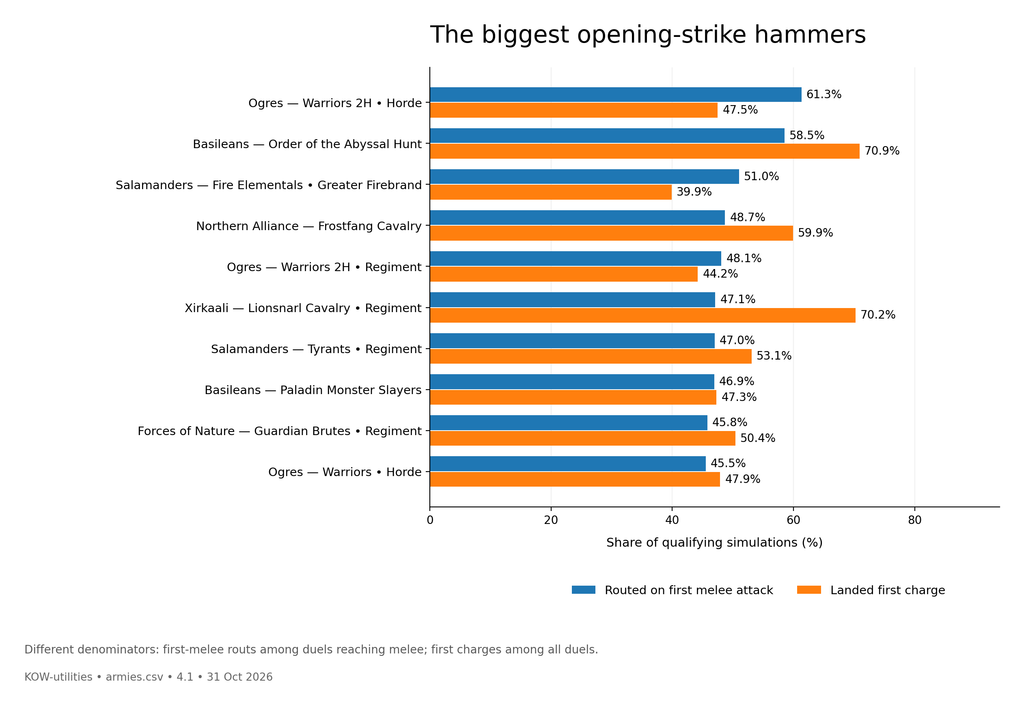
I’m not particularly surprised to see Ogres at the top. The two-handed Warriors Horde brings 30 attacks hitting on 3+, Crushing Strength 2, and Brutal 1. Against Defense 4, that is 16.7 expected wounds before the Nerve test. Against Defense 5, it still delivers 13.3. In the simulated duels where it reached melee, the unit routed its opponent with its first attack 61.3% of the time. That is the highest rate in the eligible dataset. And it comes at 275 points, substantially less than the Basilean unit immediately behind it.
There is a catch. The unit is Speed 6 and Defense 4. It landed the first charge in only 47.5% of its simulated combats. It can hit extremely hard, but getting that hit on favorable terms is another question.
The numbers suggest a straightforward role: a brutal main-line hammer that benefits from screening and carefully managed engagements. I would be cautious about treating it like an independent cavalry threat.
2. Order of the Abyssal Hunt: The strongest overall duelist
At 360 points, the Basilean Order of the Abyssal Hunt is an enormous investment. It also has the highest Elo in the current dataset: 2,615. With Speed 8, 30 attacks hitting on 3+, Crushing Strength 1, Thunderous Charge 2, and conditional Slayer attacks, it is built to hit hard and get there first. Its first-melee rout rate is 58.5%, slightly below the Ogre Horde.
But its delivery is much better. The unit landed the first charge in 70.9% of its simulated combats. That is a meaningful difference in how these units operate. The Hunt can more readily dictate an engagement. The Ogres are more dependent on creating the right conditions.
Interestingly, the Hunt’s PVR is only 0.86. That doesn’t make it weak. It means its excellent duel performance is expensive relative to the fitted baseline for units of its size and price. This is a good example of the difference between strongest and best value.
3. Fire Elementals: The surprise
The Salamander Fire Elementals with the Greater Firebrand upgrade are probably my favorite surprise in the top five. At 205 points, the regiment posts a 51.0% first-melee rout rate. Its basic expected damage is much lower than either of the two leaders, but it brings Vicious, Brutal, and a strong combination of Crushing Strength and Thunderous Charge. Its PVR of 1.17 is also notably better than the two most expensive units.
There is a delivery problem, however. The Fire Elementals landed the first charge in only 39.9% of their simulated combats. That makes them interesting as a counterpunch unit. They can punish an enemy that reaches them, but the simulation does not suggest they regularly control who gets the first charge. For 205 points, that looks like a useful offensive package.
4. Frostfang Cavalry: A more mobile hammer
Northern Alliance Frostfang Cavalry sit fourth at 48.7%. Their 30 attacks, Crushing Strength 2, and Strider make them a serious threat against armored targets. They also secured the first charge in 59.9% of simulated duels. That puts them in a different tactical category from the slower Ogre and Salamander units. They trade some raw burst for better engagement control.
At 265 points and a PVR of 0.97, they look close to the fitted efficiency baseline. The unit is expensive, but at least the simulator recognizes substantial fighting power behind that investment.
5. Ogre Warriors (2H), Regiment: A smaller hammer
The fifth-place unit is another Ogre entry. At only 185 points, the two-handed Warriors Regiment produces 10 expected wounds against Defense 4 and eight against Defense 5. Its first-melee rout rate is 48.1% (it turns out that Brutal is a great special rule to have). That is an impressive amount of opening-strike potential for something considerably cheaper than the main-line monsters at the top of the table. It also has a PVR of 1.17. For an Ogre player looking for a less expensive damage dealer, this is one of the more interesting findings in the entire analysis.
Hitting hard is different from getting the charge
The first-charge numbers deserve some attention. Consider the top two:
- Ogre Warriors (2H) Horde: 61.3% first-melee rout rate, but only 47.5% first-charge rate.
- Order of the Abyssal Hunt: 58.5% first-melee rout rate and 70.9% first-charge rate.
An army built around relatively slow, powerful infantry needs to solve the delivery problem. Screens, positioning, supporting charges, and controlling the center become essential. Faster units have more opportunities to choose when and where to commit. Xirkaali Lionsnarl Cavalry deserve an honorable mention here. They ranked sixth in first-melee rout rate at 47.1%, but landed the first charge in 70.2% of simulated duels.
If I were building a list around forcing favorable engagements, that combination would be worth investigating. Of course, first-charge frequency is not the same as a successful opening attack, and neither tells us whether the unit can win the scenario.
The two-handed Ogre experiment
The Ogre results raised another question. Are two-handed weapons actually better, or do they simply produce a more impressive first attack? Fortunately, Ogre Warriors provide a useful comparison. Their standard and two-handed profiles cost the same amount at each formation size. The two-handed version trades Defense 5 for Defense 4 and improves Crushing Strength from 1 to 2. Here is what happens.
| Size | Standard first-melee rout | 2H first-melee rout | Difference | Elo difference (2H vs standard) |
|---|---|---|---|---|
| Horde | 45.5% | 61.3% | +15.8 pp | +26 |
| Regiment | 34.8% | 48.1% | +13.2 pp | +10 |
| Troop | 24.3% | 31.9% | +7.6 pp | −50 |
Now that is interesting. The two-handed version has a higher first-melee rout rate at every formation size. But the Elo improvements are much smaller. The Horde gains only 26 Elo. The Regiment gains ten. At Troop size, the two-handed version actually finishes 50 Elo below the standard Warriors. These aren’t controlled head-to-head tests against identical opponent sets, and Elo ratings are still moving between simulation runs. Still, the pattern illustrates the tradeoff.
More damage on the first attack comes at a defensive cost. At Horde size, the offensive advantage may be enough to compensate. At Troop size, losing a point of Defense appears much harder to justify in the overall duel results.
That fits my broader view of 4th Edition. With sticky combats, surviving the response can be just as important as landing the first blow. I would be much more comfortable paying for offensive power on a unit I expect to survive long enough to exploit it.
The best budget hammers: 200 points or less
The big units are entertaining. But most armies cannot afford to spend 300-plus points every time they want something dead. So I repeated the analysis with a 200-point limit. These are the five highest first-melee rout rates under that cutoff.
| Unit | Points | First-melee rout | Duel win rate | PVR |
|---|---|---|---|---|
| Ogre Warriors (2H), Regiment | 185 | 48.1% | 62.1% | 1.17 |
| Morax, Troop | 125 | 44.8% | 44.1% | 1.07 |
| Voidtouched Mutants, Regiment | 190 | 44.0% | 62.7% | 1.10 |
| Depth Horrors, Regiment | 190 | 42.6% | 65.0% | 1.18 |
| Foot Guard (2H), Troop | 105 | 42.0% | 39.2% | 1.08 |
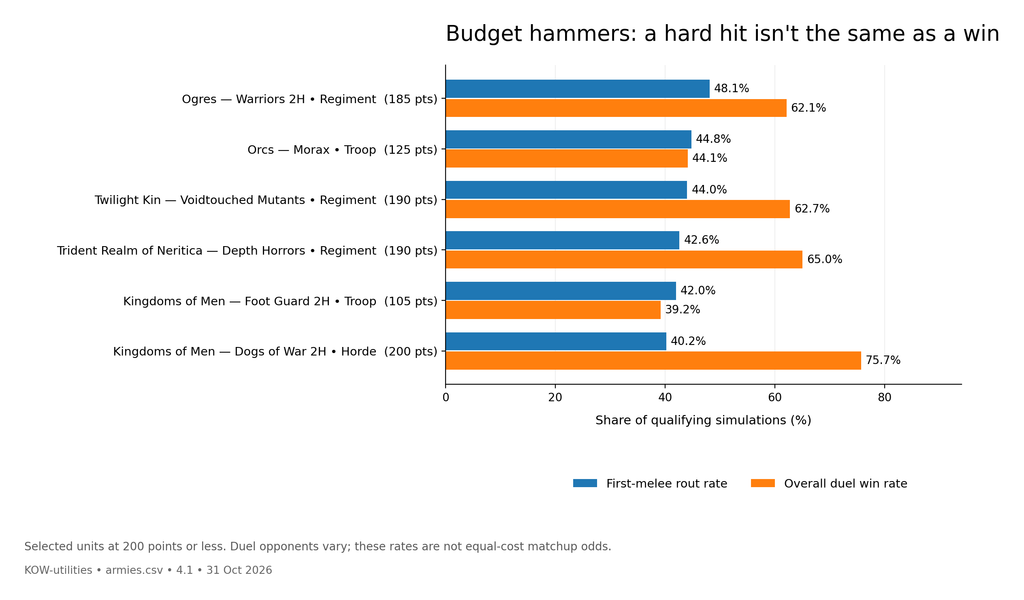
The duel win rates provide context, but they need a warning: the simulator mixes random opponents with similarly rated opponents. These percentages are not standardized, equal-points matchup odds. Even with that limitation, the difference between the cheaper troops and the more substantial regiments is worth exploring.
Morax: A cheap threat with limits
The Orc Morax Troop costs just 125 points. It has a 44.8% first-melee rout rate, which is remarkable for the price. Its overall simulated duel win rate is only 44.1%, however. I would read that as a unit with good damage potential but a much narrower battlefield role. It has the ability to punish an opponent. It is much less convincing as a unit you expect to win prolonged independent fights. That is perfectly acceptable if you build around the role. It becomes a problem when you start treating a 125-point offensive troop like a self-sufficient hammer.
Voidtouched Mutants: A strong all-round candidate
At 190 points, the Twilight Kin Voidtouched Mutants Regiment combines a 44.0% first-melee rout rate with 62.7% overall duel wins. It also has a 1.10 PVR. Twenty attacks hitting on 3+, Elite, Thunderous Charge 2, and Wild Charge make for an attractive offensive profile. The combination of speed, damage, and respectable duel results makes the Mutants worth a closer look.
The main concern is that Thunderous Charge depends on the engagement. Against Phalanx or when hindered, the output changes. That is a practical consideration for any unit whose damage depends heavily on the charge.
Depth Horrors: My budget favorite from this group
The Trident Realm Depth Horrors Regiment costs 190 points. It posts a 42.6% first-melee rout rate, 65.0% overall duel wins, and a PVR of 1.18. Of the five budget leaders, that combination looks particularly attractive. The unit brings Crushing Strength 2, with Rampage providing additional attacks against eligible targets. Unlike a unit relying heavily on Thunderous Charge, its basic Crushing Strength does not disappear when a charge is hindered. That makes it an interesting candidate for the kind of repeated close combat that Fourth Edition encourages. I would want to test it against standardized opponents before declaring it the best 190-point hammer. But this is a unit that deserves a second look.
Foot Guard: An affordable punch, not a guaranteed win
The two-handed Kingdoms of Men Foot Guard Troop costs 105 points. It has a 42.0% first-melee rout rate. That sounds fantastic until you look at its 39.2% overall simulated duel win rate. The conclusion is similar to Morax. A cheap unit can deliver a strong initial attack without being particularly good at winning an entire fight by itself. For 105 points, that may be exactly what you want. But the list needs to give the unit the right target and support.
An honorable mention: Dogs of War
One additional unit caught my attention: The Kingdoms of Men Dogs of War (2H) Horde costs exactly 200 points. It has a lower first-melee rout rate of 40.2%, putting it outside the budget top five. But its simulated duel win rate is 75.7%, and its PVR is 1.15. That is an interesting contrast with the cheaper troops. A unit that delivers a slightly less explosive first hit may still offer a much stronger overall fighting package. This is one reason I would avoid building an army entirely around a single damage statistic.
What should players take away?
I think there are three useful lessons.
First, the biggest hammer is not necessarily the best investment.
The Order of the Abyssal Hunt is the strongest overall duelist in this snapshot. It is also 360 points. Whether that is worthwhile depends on the army around it and what else those points could buy.
Second, delivery matters.
An expensive combat unit that rarely gets favorable charges can become a liability. A slightly weaker unit with more control over its engagements may prove more useful. The difference between the Ogre Horde and the Basilean cavalry illustrates this nicely.
Third, good burst damage does not guarantee good overall performance.
The Morax and Foot Guard troops are excellent examples. They can hurt things. They also have fairly modest overall duel results. Meanwhile, Depth Horrors, Voidtouched Mutants, and even the 200-point Dogs of War Horde show why it is worth looking beyond the first attack. For my own preferred grind-and-counterpunch style, that third lesson is probably the most relevant. I want units that can hit hard enough to create an advantage, survive the response, and remain relevant after the initial exchange.
What the simulator cannot tell us
I want to be careful about how much weight we put on these rankings. The simulator runs one-on-one combats. It accounts for movement, some terrain effects, combat statistics, Nerve, and many special rules. But it cannot fully reproduce the things that make Kings of War a good tournament game. It does not adequately capture the value of screening, coordinated multi-charges, scenario scoring, army-wide support, command-order decisions, or choosing favorable matchups across an entire battlefield. Some special rules remain unsupported or incompletely represented. Individual Elo ratings have also moved materially across recent runs, so I would treat close rankings as provisional.
The opponent mix is another limitation. The simulation includes random matchups and matchups between similarly rated units. As a result, the first-melee rout rates are not probabilities against one standardized target. And the sample sizes, while large in terms of simulated fights, do not turn these results into real-world tournament probabilities. I have made this distinction before, most recently in my analysis of whether Kings of War 4.1 has a horde tax. The model is good at identifying interesting combat profiles. It is much less capable of telling us whether an entire army will work.
Final thoughts
The two-handed Ogre Warriors Horde wins this round of Hammer Time. At 61.3%, it has the highest first-melee rout rate in the current dataset. The Order of the Abyssal Hunt remains the strongest overall simulated duelist and has a much better record of landing the first charge.
At 200 points or less, the Ogre Warriors Regiment, Voidtouched Mutants, and Depth Horrors all look worth investigating. The Morax and Foot Guard Troops offer interesting low-cost offensive threats, although I would be more cautious about asking them to win fights independently.
My favorite finding, though, is the two-handed Ogre comparison. It shows how much offensive power you can buy by giving up Defense—and how little of that advantage may survive when you measure the entire combat. That feels like an appropriate lesson for Fourth Edition.
The first hit matters. So does what happens afterward.
Discover more from Data & Dice
Subscribe to get the latest posts sent to your email.