UK Clash of Kings 2026 gives us something we have not had before: a very large UK field playing Fourth Edition. That makes the released lists useful for more than a normal tournament preview. We can put the 2026 field next to the 2024 and 2025 UK Clash of Kings reports and ask a straightforward question:
What actually changed when UK COK moved from Third Edition to Fourth?
I already looked at the current field in detail in UK Clash of Kings 2026: What to Watch in the Released Lists. That article focused on what players should expect this weekend: Orc pressure, Xirkaali, high-Unit Strength Ratkin and Goblins, specialist shooting, and long threat ranges.
This time I want to zoom out. The comparison suggests that Fourth Edition has clearly reshuffled what people are bringing. It has not, however, produced a UK field dominated by one or two factions. The bigger change is in the lists themselves.
The basic comparison
The three pre-tournament reports contain 195 submitted competitor lists in 2024, 203 in 2025, and 160 in 2026. Those numbers should not be treated as verified event attendance. They are simply the usable released lists in each report.
| Measure | 2024 | 2025 | 2026 |
|---|---|---|---|
| Submitted lists analyzed | 195 | 203 | 160 |
| Faction labels represented | 28 | 29 | 20 |
| Faction HHI | 524.7 | 461.8 | 569.5 |
| Largest faction share | 8.2% | 7.9% | 8.8% |
| Top-five faction share | 36.9% | 33.5% | 36.9% |
| Average units | 14.09 | 14.00 | 13.74 |
| Average Unit Strength | 24.45 | 24.60 | 26.22 |
| Average attacks | 156.3 | 155.5 | 174.1 |
| Average ranged attacks | 31.9 | 38.5 | 27.0 |
| Average magic-item points | 65.9 | 68.2 | 56.9 |
The obvious number is 20 factions instead of 28 or 29. Fourth Edition reorganized the faction structure. Some Third Edition faction labels were consolidated, removed, renamed, or otherwise changed. So this is not evidence that nine communities disappeared over the winter. The useful comparison is how players distribute themselves among the available factions. And there, the change is surprisingly modest.
The field is a little more concentrated, but still broad
HHI is one way I measure faction concentration. Lower numbers mean players are spread more evenly across factions. The 2025 UK field had an HHI of 461.8. This year it is 569.5. That is a real increase. It is also not especially alarming when you look at the actual faction shares:
The biggest faction in 2025 was Ogres at 7.9%. The biggest faction in 2026 is Orcs at 8.8%. And the top five factions account for 36.9% of the 2026 field, exactly the same percentage as in 2024. So Fourth Edition UK COK occupies fewer faction buckets, but the players are still spread broadly across those buckets. That fits pretty well with my earlier article, Early 4E Faction Diversity Looks Narrower, But the Comparison Is Messy.
The early Fourth Edition data did look much more concentrated than 2024–25. But many of those events were small. In a 15-player tournament, three or four friends arriving with the same army can move the numbers dramatically. A 160-list UK COK sample is much harder to move that way. The result makes me a little less concerned about faction-level compression than I was earlier this year. The field has narrowed structurally but it has not collapsed competitively into a handful of armies.
The factions people want to play have changed a lot
This is where the edition reset becomes much more obvious.
| Faction | 2024 | 2025 | 2026 |
|---|---|---|---|
| Orcs | 1.0% | 2.5% | 8.8% |
| Forces of Nature | 2.6% | 1.5% | 7.5% |
| Kingdoms of Men | 1.0% | 2.5% | 6.9% |
| Dwarfs | 8.2% | 3.4% | 6.3% |
| Nightstalkers | 3.1% | 3.0% | 5.6% |
| Ogres | 8.2% | 7.9% | 5.6% |
| Abyssal Dwarfs | 5.6% | 5.4% | 1.9% |
| Basileans | 2.6% | 4.4% | 1.3% |
Xirkaali add another 5.6% of the 2026 field, but obviously have no Third Edition UK COK baseline. Orcs are the clearest breakout. Only two of the 195 analyzed lists in 2024 were Orcs. Five of 203 were Orcs in 2025. There are 14 this year. Their share has gone from 1.0% to 2.5% to 8.8%. That is a remarkable shift in player choice. It also fits the current list data. The 2026 Orcs average 178 attacks and 84.7 calculated expected damage while bringing very little shooting. Greatax, Gore Riders, Godspeakers, Riftforged Legionaries, and Helstrikers appear repeatedly across the field. I went deeper on why the army works in Orcs in Kings of War 4th Edition: Best Units, Strategy, and Tournament Analysis. UK COK should give us a much better test of whether that theoretical efficiency converts into tournament results.

Forces of Nature are almost as striking. Nature went from five lists in 2024 to only three last year and now has 12. Kingdoms of Men have gone from two, to five, to 11. Those are substantial changes in what players apparently want from their armies.
Ogres are no longer the default UK COK heavyweight
The other side of the table is just as interesting. Ogres were tied for the largest faction in 2024 with 16 lists. They were the outright largest in 2025, again with 16. This year there are nine. They have moved from roughly 8% of the field in both Third Edition events to 5.6%.
Abyssal Dwarfs fall even further, from 11 lists in both 2024 and 2025 to three. Basileans go from nine last year to two. I would be careful drawing balance conclusions from any of those changes. Representation tells us what players chose to bring. It does not tell us why they chose it or whether the resulting army is actually weak. But the field definitely feels different before the first dice roll.
The center of gravity has moved away from Ogres and several familiar late-3E factions toward Orcs, Nature, Kingdoms of Men, and the new Xirkaali. Forces of the Abyss and Salamanders are useful counterexamples. Their shares remain around 6–7% despite the edition change. Not everything reset.
The average list did not get bigger
This may be my favorite finding in the comparison. The average UK COK army contained:
14.09 units in 2024. 14.00 units in 2025. 13.74 units in 2026. Basically flat.
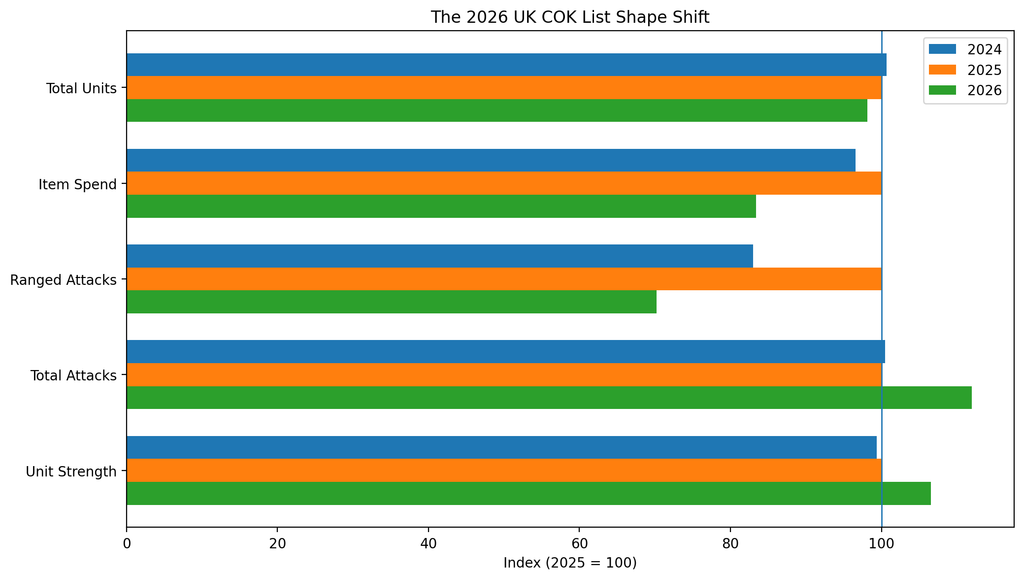
And yet the average 2026 army has noticeably more stuff that matters for fighting and scoring. Unit Strength rises from 24.6 last year to 26.2 (though note that individuals scoring is basically what is driving this change). Total attacks rise from 155.5 to 174.1. That is about a 12% increase in attacks without increasing the number of units. That is a much more interesting description of the Fourth Edition shift than saying armies are simply larger or more spammy.
They are not bringing more units; they are bringing units that collectively carry more board weight and more combat output. We saw something very similar when I compared the 2024–26 US Masters fields in 2026 Kings of War US Masters Preview: Goblins, Gunlines, and the 4E Damage Shift. That makes me more confident this is a real Fourth Edition list-building signal rather than a weird UK-only result.
Shooting has moved sharply in the other direction
The most dramatic list-shape change is shooting. UK COK averaged 31.9 ranged attacks in 2024. That rose to 38.5 in 2025. Now it is 27.0. Compared with last year’s field, that is almost a 30% decline. That lines up with the broader tournament data I looked at in Is Shooting Dead in Kings of War 4th Edition? The Data Says Not Quite.
The safest description remains the same: less shooting overall, not no shooting. UK COK still has some serious gunlines. Halflings average 57.5 ranged attacks. Empire of Dust average 57.4. Elves average 53.7. Individual armies go well above 100. The difference is that shooting is less central to the normal list. Points that used to support general ranged pressure appear to be finding their way into scoring presence and combat output instead. For players, that probably means ranged pressure is becoming more matchup-specific. You may face fewer armies where shooting is a constant background tax. When you do draw the dedicated gunline, however, it can still be very real.
Players are spending less on magic items too
There is another quiet change that I think is worth watching. Average magic-item spend increased from 65.9 points in 2024 to 68.2 in 2025. This year it drops to 56.9. The median falls even harder, from 65 points last year to 45.
Some of that could simply reflect Fourth Edition item economics. Item costs and the surrounding rules changed, so I would not turn the number into a claim that players suddenly care less about artifacts. But it does fit the broader shape of the field. The 2026 lists seem to be putting relatively more of their value directly onto the table through Unit Strength and combat pieces rather than through item spend. Sir Jesse’s Boots of Striding are still everywhere, but the overall item budget is simply lower.
Diversity is really two different questions
I think the UK comparison helps clean up something I have been wrestling with in the Fourth Edition data. Faction diversity and list diversity are not the same thing. At the faction level, UK COK is still broadly distributed. Inside factions, there is more evidence that players are finding common cores.
About 25% of the 2026 UK lists contain four or more copies of the exact same unit and formation size. The comparable late-Third Edition figure in my broader dataset was 19.3%. That is an increase, but still well below the 34.1% rate from the earlier pooled 4E sample. I dug further into that question in Are Fourth-Edition Kings of War Lists Getting Less Diverse?.
UK COK reinforces the more nuanced answer. The tournament does not look like 160 people choosing from three armies. It does look like players within some factions increasingly agree on which units belong in the starting chassis. Those are very different concerns.
So what actually changed from 3E to 4E?
My read is that the first Fourth Edition UK COK looks more like a redistribution of competitive priorities than a collapse of army choice. The faction menu is smaller. Orcs, Forces of Nature, Kingdoms of Men, and Xirkaali occupy much more of the field than their equivalent late-3E positions. Ogres, Abyssal Dwarfs, and Basileans occupy less.
But once those faction choices are made, the average list still contains about 14 units. Those units now bring more Unit Strength and considerably more attacks. At the same time, the average army brings less shooting and spends fewer points on magic items. That is a fairly coherent picture.
Fourth Edition UK COK looks like a field leaning harder into board presence and decisive combat. The results will tell us whether that is actually the right answer.
Other UK COK previews and where to watch
There is plenty of coverage available if you want something less spreadsheet-shaped before the weekend.
The two UK COK video previews shared with me are here: 2026 UK Clash of Kings preview video and a second 2026 UK Clash of Kings preview.
Mantic Universe Podcast also released Episode 211: MUP Kings of War — Clash of Kings UK 2026 this week. Matthias, Danny, and Menai talk through their plans and lists for Nottingham.
And if you are not there in person, the tournament livestream is scheduled here: UK Clash of Kings 2026 livestream.
I will come back to the data after the event. The question then will be much better than “what did people bring?” We will finally get to ask which parts of the Fourth Edition field actually worked.