Orcs were the most common faction across these 17 tournaments, accounting for 9.0% of recorded faction appearances. Their observed score rate was 50.4%. Ratkin made up only 3.9% of the sample and scored 77.6%. That comparison does not settle which faction is stronger. It points toward a more useful tournament question: how much value did each army gain from the field around it?
A faction can look average in isolation and still be an excellent tournament choice when its favorable matchups are common. Another faction can have strong units and good lists but lose value when the armies it struggles against occupy a large share of the room. With the tournament dataset I’ve been compiling on https://kow-dataset.web.app/, Ratkin had an expected score rate of 59.8% against this field. Goblins were next at 54.3%. Nightstalkers and Basileans faced the opposite problem, with expected rates close to 45%.
That is the second-order meta. The army matters, but so do the armies standing across the table.
TL;DR: Ratkin had the clearest matchup advantage against the current field, while Goblins gained value because their best matchups included several of the game’s most popular factions.
What this analysis measures
The dataset includes 1,485 recorded faction results from 17 tournaments and 20 factions. A win is worth one point, a draw half a point, and a loss zero. I use “score rate” throughout the article because that is slightly different from a straight win percentage. For each faction, the expected field score is calculated as: Expected field score = Σ (opponent field share × matchup score rate)
The matchup rates are pulled toward 50% using a small prior equivalent to five neutral games. That keeps a faction from appearing unbeatable because it happened to win its only recorded game against an opponent. The final “field-benefit” score is simply the faction’s expected score rate minus 50%. A positive result means the current faction mix looks favorable. A negative result means the field contains more difficult matchups.
This is a planning estimate rather than an independent prediction. The same tournament records help build both the matchup matrix and the observed results, and many matchup cells remain small. It identifies useful patterns, but it cannot separate faction strength from player skill, list quality, scenario, terrain, or pairing luck.
The field is broad, but it is not flat
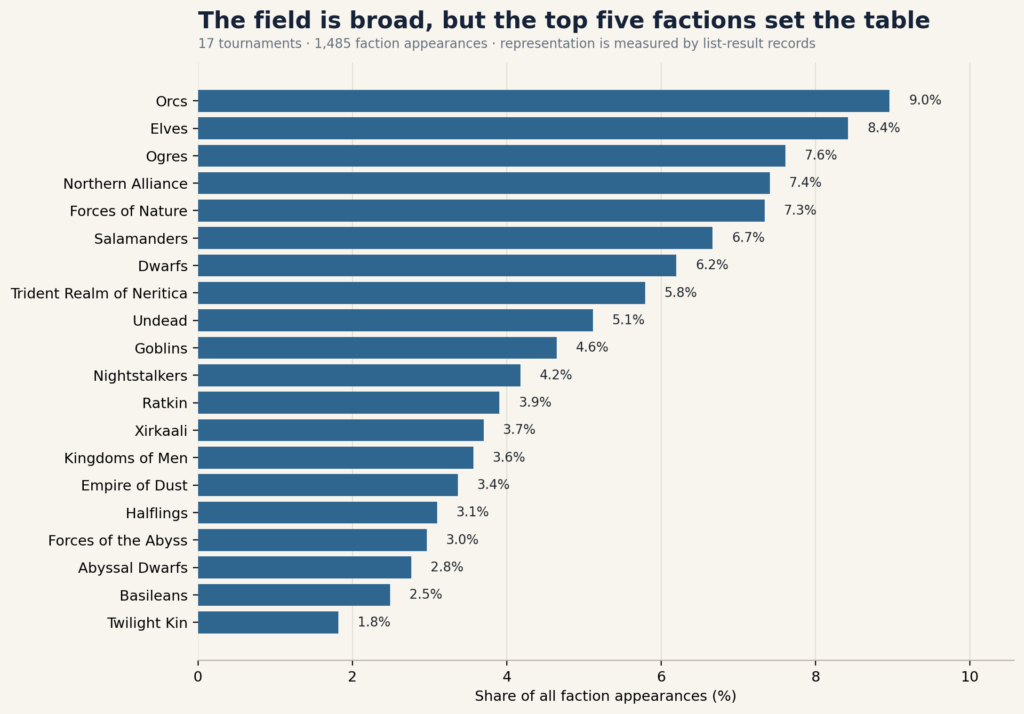
No faction reached 10% of the field, but the eight most common factions accounted for 58.4% of all recorded appearances.
The current field has plenty of variety. Orcs led at 9.0%, followed by Elves at 8.4%, Ogres at 7.6%, Northern Alliance at 7.4%, and Forces of Nature at 7.3%. Those five factions accounted for 39.7% of the sample. Add Salamanders, Dwarfs, and Trident Realm of Neritica, and the top eight reach 58.4%. That gives players a useful target without turning the field into a narrow five-faction meta. You cannot build only for Orcs and Elves, but a list that performs well into the popular middle of the field should see that advantage repeatedly over a five- or six-round event.
The representation numbers also show why raw popularity can be misleading. Orcs were the most common faction, but their expected score against the field was 51.0%, and their observed score was 50.4%. They helped define the environment without dominating it. Ratkin occupied a much smaller share of the room, but their matchup spread lined up extremely well with what everyone else brought.
The matchup map has clear lanes
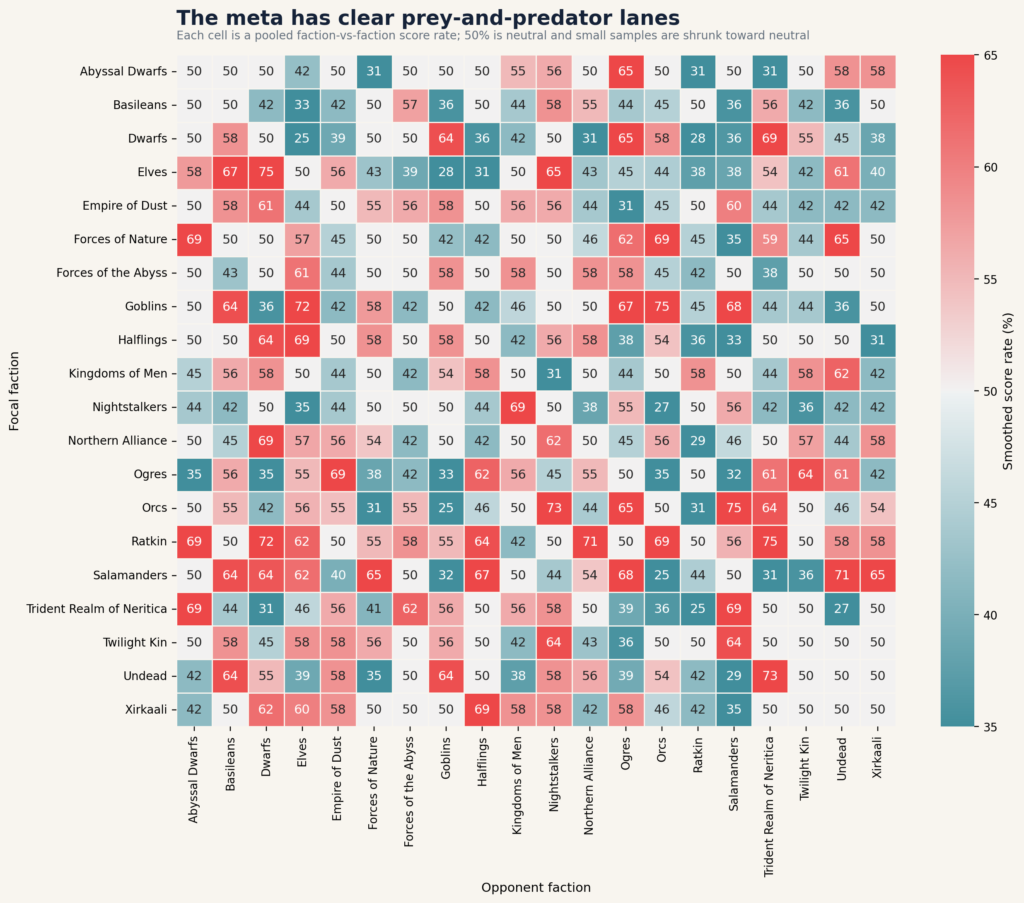
Warm cells represent favorable results for the faction on the left. Teal cells show difficult matchups. Values near 50% may indicate a balanced matchup, a small sample, or no useful evidence yet.
The heatmap explains where the second-order advantage comes from. Several of the strongest recorded lanes involved factions near the top of the representation chart:
- Elves scored 75.0% into Dwarfs across nine records.
- Ratkin scored 75.0% into Trident Realm across five.
- Ratkin scored 70.8% into Northern Alliance across seven.
- Goblins scored 75.0% into Orcs across five.
- Salamanders scored 71.4% into Undead across nine.
- Orcs scored 75.0% into Salamanders across five.
These are meaningful practice targets, but they are not settled faction truths. A five-game matchup can still be driven by one player, one list design, or one event. The shrinkage helps, but it does not manufacture information. There are also 43 directed faction pairings without a recorded matchup in the supplied summary. Those cells effectively sit at neutral in the field calculation. A 50 on the heatmap should therefore be read as “no demonstrated advantage,” rather than proof that the matchup is perfectly balanced.
Ratkin had the best field position
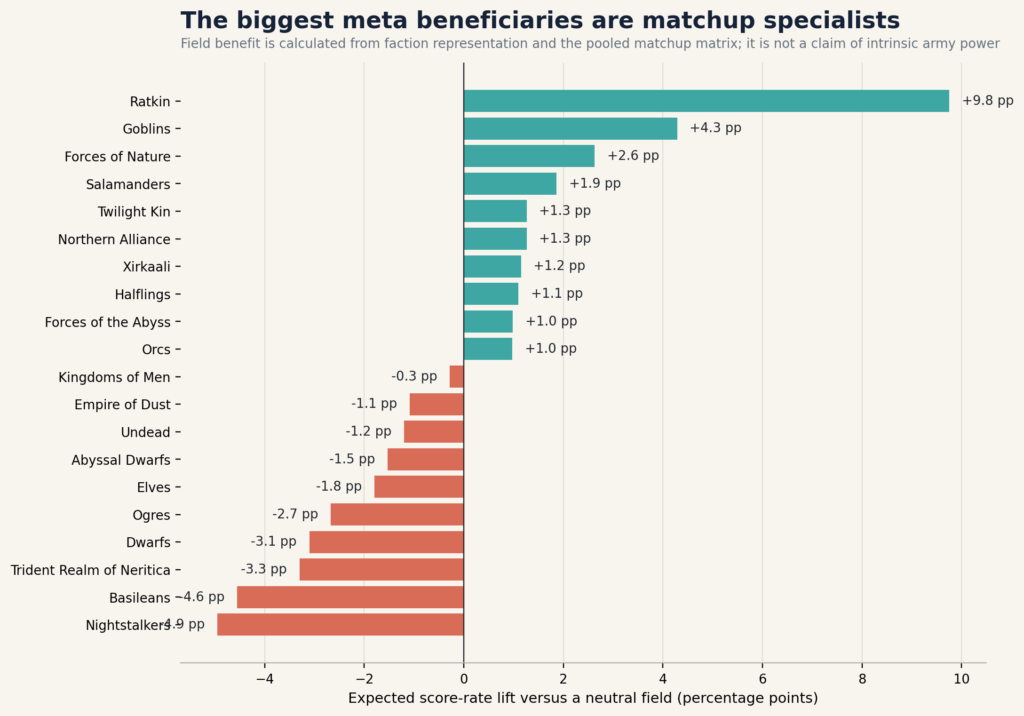
Ratkin gained almost 10 expected percentage points from the current faction mix. Goblins were a distant but clear second.
Ratkin were the clearest beneficiary by a wide margin. Their expected score rate was 9.8 percentage points above neutral, more than twice the lift calculated for Goblins. This was also a relatively broad advantage. Ratkin posted a score above 50% in 13 of their 16 observed non-mirror matchups. Only one observed matchup finished below neutral, while two were exactly neutral after shrinkage. Most of the expected lift came from five popular opponents:
- Orcs contributed about +1.7 points to Ratkin’s overall expectation.
- Northern Alliance contributed +1.5.
- Trident Realm contributed +1.5.
- Dwarfs contributed +1.4.
- Elves contributed +1.1.
Those five factions represented more than one-third of the entire field. Ratkin were not relying on one obscure matchup to produce a strong number. Their favorable lanes ran through armies players were reasonably likely to see. The observed results were even stronger. Ratkin scored 77.6% across 58 recorded appearances and exceeded their event-level expectation at four of the five tournaments where they appeared. The results included 79.2% at US Masters, 70.0% at Bugeater, and 90.0% at Adepticon (and that isn’t all Sean Troy just rolling people). That is still a small and clustered sample. It is enough to treat Ratkin as a genuine meta constraint, but not enough to decide whether the faction, its strongest lists, or its player pool deserves most of the credit.
Goblins benefited in a different way
Goblins had a 4.3-point expected field benefit, but their matchup map was much less uniform. They had six observed matchups above 50%, nine below it, and two at neutral. That looks more like a specialist than a broad all-purpose faction. The important detail is where the good matchups appeared:
Goblins gained about 2.2 expected percentage points from their results into Orcs, 1.9 from Elves, 1.3 from Ogres, and 1.2 from Salamanders. Those four factions made up almost one-third of the sample. Their difficult lanes included Dwarfs and Undead, but those negative contributions were smaller than the benefit generated by their results into the most popular factions. That is a clean example of second-order value. Goblins did not need to beat everything. They needed their best pairings to be common enough to matter. Their 57.2% observed score rate was close to the 54.3% field estimate, which suggests the favorable portfolio translated reasonably well without producing the kind of extreme residual seen for Ratkin.
Forces of Nature and Salamanders were more conditional
Forces of Nature gained 2.6 expected points from the field. Much of that came from favorable results into Orcs, Ogres, Undead, Elves, and Trident Realm. Salamanders were the major offset. That leaves Forces of Nature in a useful position. The faction was already one of the five most common armies, and its matchup profile remained slightly favorable against the rest of the field. Salamanders finished with a smaller 1.9-point field benefit, but their spread was more volatile. They performed well into Ogres, Forces of Nature, Undead, Elves, and Dwarfs while giving much of that value back against Orcs, Trident Realm, and Goblins.
For a Salamanders player, predicting the local field may matter more than the pooled number. The event-level estimate ranged from 43.9% to 58.8% across the tournaments where Salamanders appeared. Some of that range comes from very small events, but a 15-point swing is still enough to change how attractive the faction looks. That may be the best follow-up to this analysis: measure how much each faction’s expected value changes from event to event rather than relying only on the global field.
Popular factions did not suffer much from mirror matches
One question going into the analysis was whether faction popularity hurts performance by creating more mirrors. A strong faction facing itself moves back toward a neutral 50% result. The effect was present, but small: Ratkin’s expected score would rise by only about 0.4 points if mirror matches were excluded. The estimated mirror drag was around 0.2 points for Goblins and Forces of Nature. No faction moved enough for mirrors to change the main ranking. At the current representation levels, matchup quality against other popular factions matters far more than mirror frequency. A faction would need a much larger share of the field before mirrors became a major constraint.
Some factions faced a hostile field
Nightstalkers had the lowest expected score rate at 45.1%. Their difficult lanes included Orcs, Elves, Northern Alliance, Trident Realm, and Undead. Four of those five factions were among the nine most common armies in the sample. Basileans followed at 45.4%. Their largest negative contributions came from Elves, Salamanders, Undead, Goblins, and Dwarfs. Dwarfs and Trident Realm also landed near 47%. Both factions had several strong individual matchups, but the full field mix worked against them.
This does not mean those armies cannot win. It means they entered tournaments with less room for error. A faction starting with an expected score around 45% needs stronger lists, better execution, better pairings, or some combination of the three to reach the top tables.
Ratkin also exceeded the field estimate
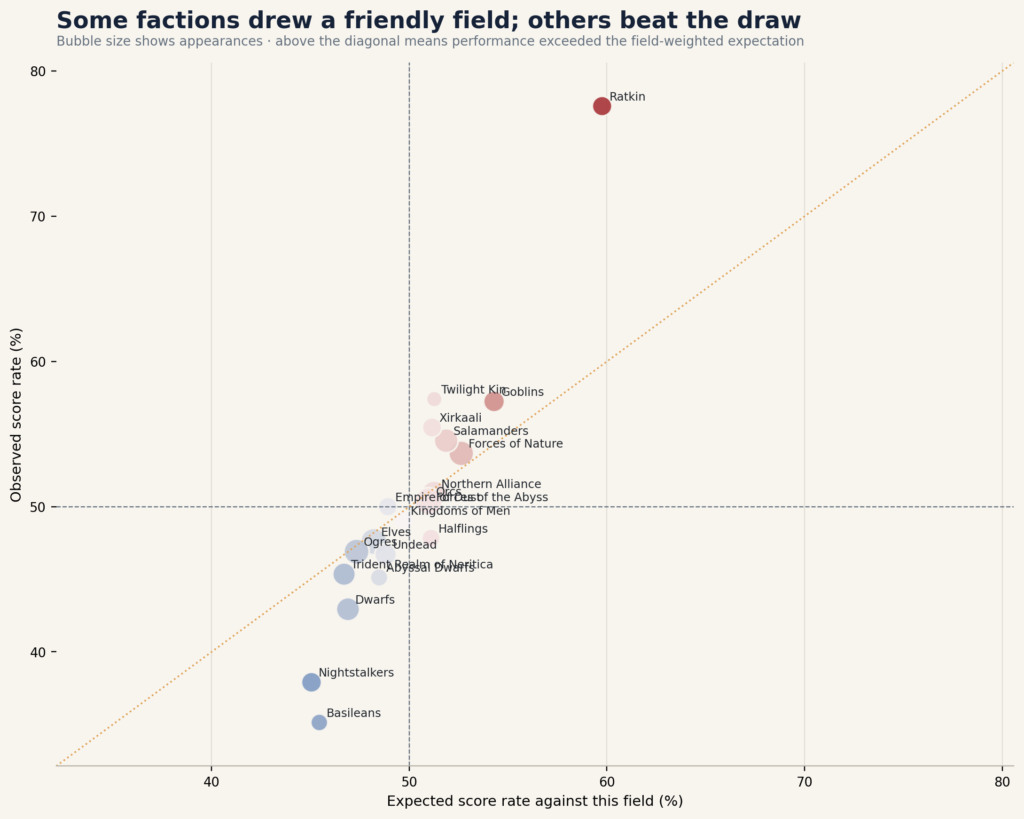
Factions above the diagonal scored better than their field-weighted matchup estimate. The gap is a follow-up signal rather than a clean measure of player skill.
Ratkin were the clear outlier in the expected-versus-observed comparison. Their expected score was already strong at 59.8%, but the observed result reached 77.6%. Twilight Kin also finished above expectation, scoring 57.4% against an estimate of 51.3%. Xirkaali posted 55.5% against 51.2%. At the other end, Basileans scored 35.1% against an expected 45.4%, while Nightstalkers scored 37.9% against 45.1%. The vertical gap should be treated carefully. It includes player strength, list design, actual opponents drawn, event composition, the shrinkage model, and ordinary variance. Because the matchup rates and observed scores come from the same pooled data, this is not a clean out-of-sample forecast.
What players should do with this
A tier list can tell you which factions have been performing well. It cannot tell you whether those factions fit the tournament you are about to attend. A better preparation process starts with the likely field. Estimate which armies will be common in your region or at your event. Identify the matchups that contribute the most to your faction’s expected performance. Then decide whether your list needs to improve a common bad matchup or protect an advantage you already have.
The sample also argues against overreacting to one favorable pairing. A strong matchup against a faction that represents 2% of the field will rarely define a six-round tournament. A smaller edge into Orcs, Elves, Ogres, or Northern Alliance may be more valuable because it has a better chance of appearing in the actual draw.
For Ratkin players, the current field looks favorable across several common factions. Goblin players have a more specialized opportunity, with strong results into several popular armies and clear weaknesses elsewhere. Nightstalker and Basilean players should pay close attention to local composition because the pooled field offered them very little help. The practical question before an event is straightforward: How many of my likely rounds are against factions my list is built to handle? That gets closer to tournament value than asking which faction sits at the top of a universal ranking.