Introduction
This post updates my unit cost-effectiveness analysis for the Clash of Kings 2025 rules, using Elo ratings from 1.25 million combat simulations. Background on the method is here. CoK 2025 is new, and Elliot is still fixing errors in the Mantic Companion. Those changes may affect the results, so please let me know if you spot an error.
Methodology
Data Collection and Preparation
I compiled unit data from CoK 2025, including faction, unit name, type, size, and combat statistics. I excluded units marked ‘I’ (Individual) because their special rules and buffs make them difficult to compare through direct combat simulations. For missing critical values, I either used defaults or omitted incomplete entries.
Elo Rating System Implementation
Each unit was assigned an initial Elo rating of 1500. The Elo rating system, traditionally used in competitive games, was adapted to evaluate unit performance based on simulated combat outcomes. The rating updates were governed by a dynamic K-factor, which decreased linearly from 100 to 1 over the course of the simulations, allowing the system to stabilize as more data was collected.
Combat Simulations
A custom-built combat simulator executed 1.25 million battles between randomly paired units. The selection process balanced between random pairings and matches between units with similar Elo ratings, promoting a comprehensive evaluation across the performance spectrum. Each simulation consisted of multiple rounds, with outcomes recorded to update the respective units’ Elo ratings.
Cost-Effectiveness Analysis
Post-simulation, the cost-effectiveness of each unit was assessed using two primary metrics:
- Elo per Point: This metric was calculated by dividing a unit’s final Elo rating by its point cost, providing a direct measure of performance relative to cost.
- Elo Difference: A linear regression model predicted expected Elo ratings based on unit cost and size. In other words, different base sizes for units have different performance expectations, and this metric attempts to correct for that by comparing units versus their footprint size’s expected performance. The Elo Difference was determined by subtracting the predicted Elo from the actual Elo, highlighting units that outperformed or underperformed expectations.
These metrics were standardized and combined, with a weighting of 60% for Elo per Point and 40% for Elo Difference, to formulate a Composite Cost-Effectiveness score for each unit.
Results
Top Cost-Effective Units
The analysis identified the top cost-effective units across various types and sizes. I plan to get into more detail in future posts, but here’s a quick preview. Below is the updated summary table of the top cost-effective units by Type and Size:
Cavalry
| Faction | Name | Type | Size |
|---|---|---|---|
| Forces of the Abyss 2024 | Abyssal Horsemen | Cavalry | R |
| Forces of the Abyss 2024 | Abyssal Horsemen | Cavalry | T |
| Dwarfs | Berserker Brock Riders | Cavalry | T |
| Free Dwarfs | Free Dwarf Berserker Brock Riders | Cavalry | T |
| The Order of the Green Lady | Order of Redemption | Cavalry | R |
Chariot
| Faction | Name | Type | Size |
| Riftforged Orcs | Fight Wagons | Chariot | H |
| Riftforged Orcs, Orcs | Fight Wagons | Chariot | L |
| Orcs, Riftforged Orcs | Fight Wagons | Chariot | R |
| Orcs, Riftforged Orcs | Fight Wagons | Chariot | T |
| Empire of Dust | Reanimated Behemoth | Chariot | M |
Heavy Infantry
| Faction | Name | Type | Size |
| Salamanders | Ancients | Heavy Infantry | R |
| Salamanders | Ancients | Heavy Infantry | T |
| Sylvan Kin, The Herd, Elves, Forces of Nature | Hunters of the Wild | Heavy Infantry | T |
| Orcs, Riftforged Orcs | Reborn Legionaries | Heavy Infantry | T |
| Salamanders | Salamander Primes | Heavy Infantry | H |
Infantry
| Faction | Name | Type | Size |
| Forces of the Abyss 2024 | Abyssal Guard | Infantry | T |
| Abyssal Dwarfs, Ratkin Slaves | Immortal Guard | Infantry | T |
| Empire of Dust, Undead | Mummies | Infantry | T |
| Basileans | Paladin Foot Guard | Infantry | T |
| Empire of Dust, Undead | Revenants | Infantry | T |
Large Cavalry
| Faction | Name | Type | Size |
| Kingdoms of Men | Beast Cavalry | Large Cavalry | R |
| Nightstalkers | Fiends | Large Cavalry | R |
| Varangur, Northern Alliance | Frostfang Cavalry | Large Cavalry | H |
| Varangur, Northern Alliance | Frostfang Cavalry | Large Cavalry | R |
| League of Rhordia | Honour Guard | Large Cavalry | R |
Large Infantry
| Faction | Name | Type | Size |
| Forces of Nature, Free Dwarfs, Dwarfs, The Order of the Green Lady, The Herd | Earth Elementals | Large Infantry | R |
| Empire of Dust | Enslaved Guardians | Large Infantry | R |
| Salamanders | Tyrants | Large Infantry | R |
| Forces of Nature | Water Elementals | Large Infantry | R |
| Undead | Zombie Trolls | Large Infantry | H |
Monster
| Faction | Name | Type | Size |
| Undead | Goreblight | Monster | M |
| Salamanders | Greater Fire Elemental | Monster | M |
| The Order of the Green Lady, Trident Realm of Neritica, Forces of Nature | Greater Water Elemental | Monster | M |
| Twilight Kin | Impaler Soulbane | Monster | M |
| Varangur, Northern Alliance | Snow Troll Prime | Monster | M |
Monstrous Infantry
| Faction | Name | Type | Size |
| Twilight Kin | Impalers | Monstrous Infantry | R |
| Abyssal Dwarfs | Lesser Obsidian Golems | Monstrous Infantry | H |
| Abyssal Dwarfs | Lesser Obsidian Golems | Monstrous Infantry | R |
| Forces of the Abyss 2024 | Molochs | Monstrous Infantry | H |
| Forces of the Abyss 2024 | Molochs | Monstrous Infantry | R |
Swarm
| Faction | Name | Type | Size |
| Empire of Dust | Desert Swarm | Swarm | R |
| Forces of the Abyss 2024 | Imps | Swarm | R |
| Free Dwarfs, Dwarfs | Mastiff Hunting Pack | Swarm | R |
| Abyssal Dwarfs | Mutated Mastiff Hunting Pack | Swarm | R |
| Riftforged Orcs, Orcs | Orclings | Swarm | R |
Titan
| Faction | Name | Type | Size |
| The Herd, Free Dwarfs, The Order of the Green Lady, Dwarfs, Forces of Nature | Greater Earth Elemental | Titan | Ti |
| Abyssal Dwarfs | Greater Obsidian Golem | Titan | Ti |
| Abyssal Dwarfs | Infernok | Titan | Ti |
| Nightstalkers | Portal of Despair | Titan | Ti |
| Empire of Dust, Undead | Revenant on Undead Great Burrowing Wyrm | Titan | Ti |
War Engine
| Faction | Name | Type | Size |
| Elves | Dragon Breath | War Engine | WE |
| Abyssal Dwarfs | Dragon Fire-Team | War Engine | WE |
| Dwarfs | Flame Belcher | War Engine | WE |
| Northern Alliance | Ice Kin Bolt Thrower | War Engine | WE |
| Dwarfs | Ironbelcher Organ Gun | War Engine | WE |
Visualization
The violin plot below visualizes the distribution of cost-effectiveness scores across different unit types. It provides insights into the variability and central tendencies within each category, aiding in comparative analysis:
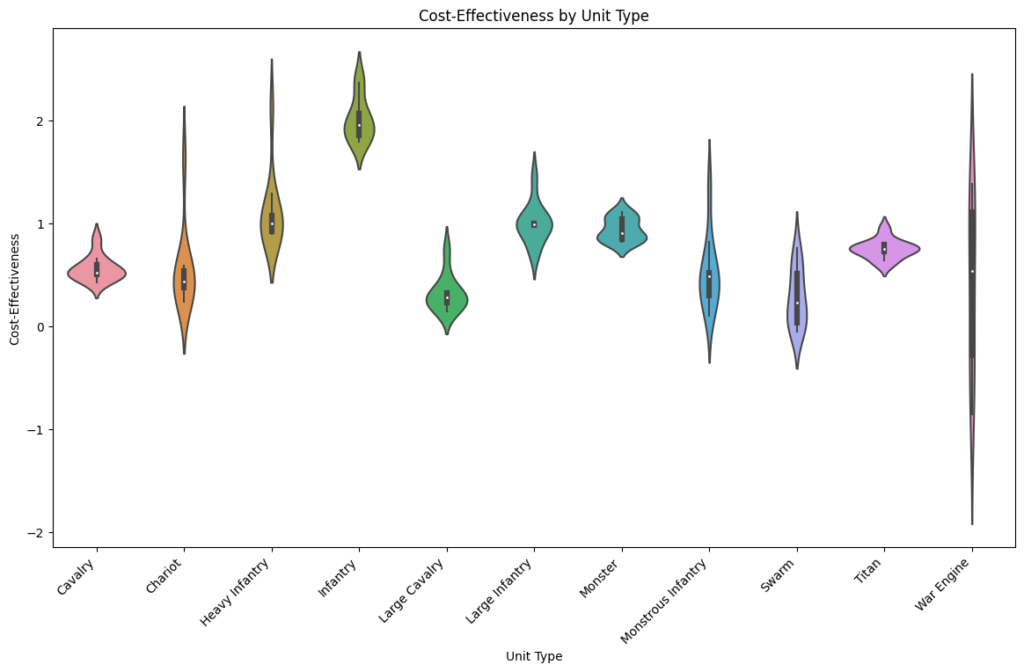
The chart shows which unit types provide higher average value for their points and which have more variable results. War engines, chariots, and monstrous infantry span a wide range; cavalry, monsters, and titans have tighter results.
Conclusion
Combining Elo ratings and points cost gives a framework for comparing unit efficiency. Players can use the results as one input for list building, and I can update the analysis when rules change.
I plan to look at specific armies next. Let me know which unit types or factions you would like to see in a future breakdown.