Back in my earlier post I made the case that, despite some doomsaying, the data showed a thriving Kings of War tournament scene. Since then, I’ve expanded my dataset and analysis, and the updated numbers only strengthen the conclusion: our community is alive and well.
How the Data Gets Built
For those curious, here’s the short version of my pipeline:
event_crawler.pyscrapes event listings and results directly from the Mantic Companion. It’s messy work, because there’s no public API (yet — Ronnie, if you’re feeling generous, an API would make this much easier and more accurate).kow_etl.pycleans and normalizes the raw CSVs into proper tables: tournaments, players, matches, and player–matches. Player names are standardized so that “Jon Carter” and “Jon C.” don’t show up as two different people.kow_analysis.pythen runs the metrics: win rates, attendance trends, scene concentration, and meta diversity. Outputs are written to CSVs for inspection and plotting.
The result is a much larger, cleaner dataset than when I first wrote on this topic.
Diversity of Armies
One of the most important questions is whether the meta has narrowed to just a handful of competitive factions. I looked at this using three related metrics.
| Season | Faction Diversity HHI | Effective Factions (HHI) | Shannon Entropy | Effective Factions (Shannon) |
|---|---|---|---|---|
| 2022 | 111.1 | 9 | 2.3 | 10.4 |
| 2023 | 55.5 | 18 | 3.1 | 22.4 |
| 2024 | 52.5 | 19 | 3.2 | 23.9 |
| 2025 | 52.8 | 18.9 | 3.2 | 23.6 |
Caption: Faction diversity remains strong across all metrics, with effective faction counts well above 18 in recent seasons.
- Herfindahl–Hirschman Index (HHI): Measures concentration. If one faction dominates, HHI goes up.
- Effective number of factions (from HHI): A friendlier way to read the same data: how many factions does the scene “feel like,” given actual usage.
- Shannon entropy & effective factions: Another diversity measure that rewards both balance and breadth.
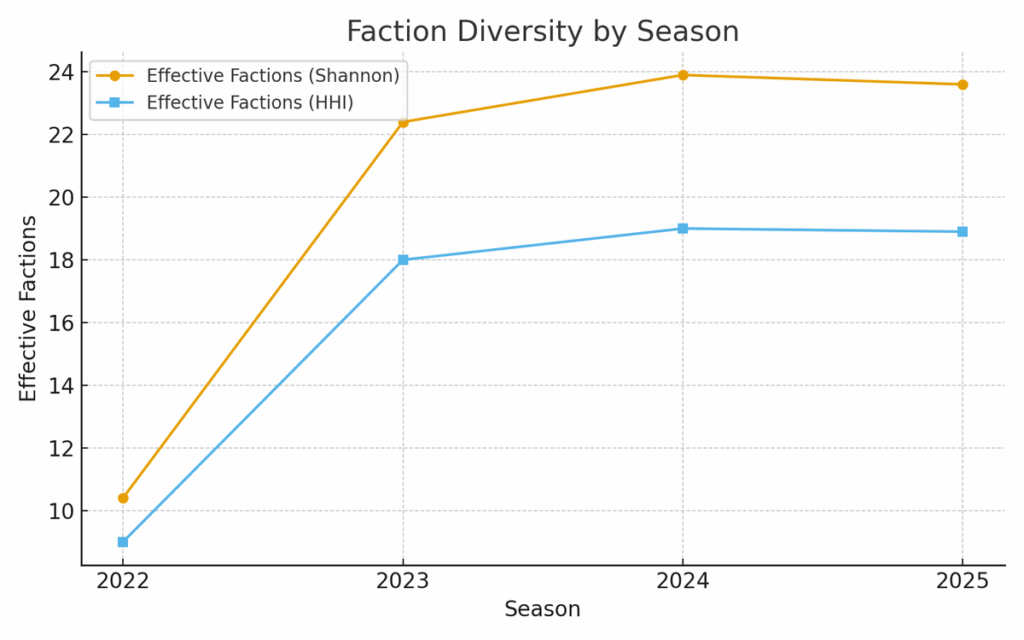
The results are consistent across methods. Even when controlling for sample size (2022 was still ramping up, 2025 isn’t finished yet), faction diversity is very strong. Nearly every army in the game is showing up, and no single faction is crowding the rest out.
Tournament Attendance
Attendance trends also paint a healthy picture. Using the attendance_health_by_season.csv outputs:
| Season | Events | Median Size | 25th %ile | 75th %ile | Median Rounds | Avg Rounds | Median Points |
|---|---|---|---|---|---|---|---|
| 2022 | 23 | 10 | 10 | 10 | 4 | 4.1 | 2000 |
| 2023 | 140 | 12 | 8 | 16 | 3 | 3.8 | 2300 |
| 2024 | 140 | 14 | 10 | 18 | 3 | 3.6 | 2300 |
| 2025 | 101 | 14 | 10 | 18 | 3 | 3.5 | 2300 |
- Typical game size: Median points values land right at 2300 — the community standard.
- Tournament sizes: The 25th/75th percentiles are rising, which means both the small one-dayers and the larger GTs are well attended.
- Rounds per event: The median is about 3.5 — a steady mix of short, local events and full GT weekends. That balance hasn’t shifted much.
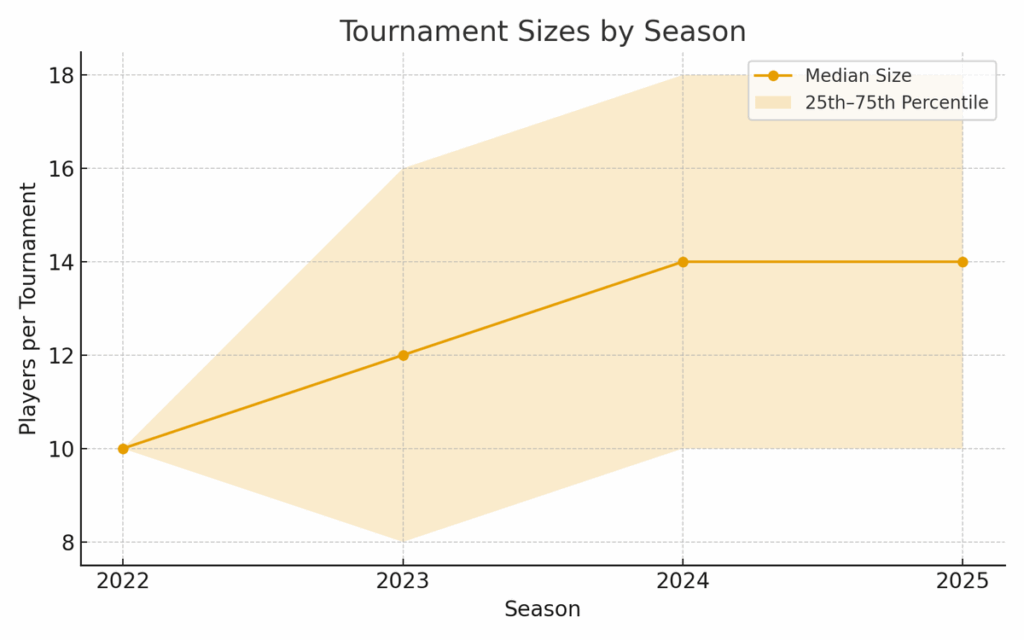
Taken together, it’s exactly what you’d want to see: a growing number of well-sized events that fit different player needs.
Scene Health Beyond Attendance
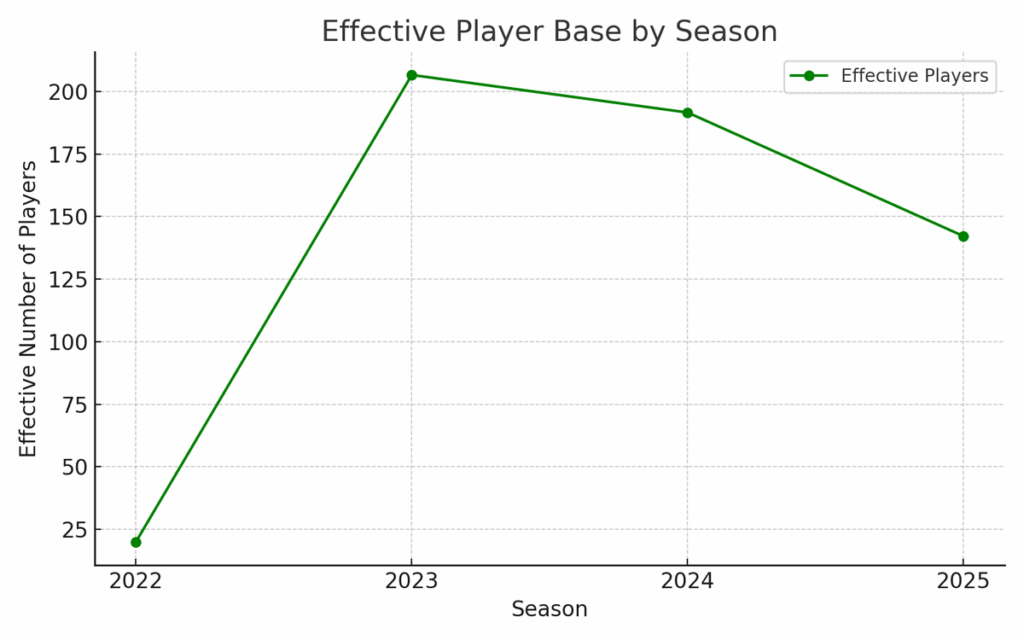
I also checked player concentration (Scene HHI). Here the metric asks: is the same small clique entering everything, or do we see broad participation? The answer is encouraging — effective player counts are high, and unique participation is strong across seasons. This is what keeps the game sustainable: new and returning players mixing into the pool.
TL;DR
When you zoom out across multiple years, the Kings of War tournament scene is not just alive–it’s healthy and diverse.
We’ve got stable attendance, balanced faction representation, and a steady pipeline of events ranging from locals to GTs. If there’s a “problem” in the data, it’s that scraping it from Companion is still too hard. (Ronnie, API, please?)
Until then, I’ll keep updating this dataset and reporting back. If you’re on the fence about attending your local event, the numbers are clear: it’s a good time to be rolling dice in Pannithor.