On paper, Orcs in 4th Edition look like one of the easiest armies in the game to understand. The old Orc and Riftforged toolsets were folded into one list, the roster gained a huge spread of Core melee options, and the faction has command-order mechanics that can either extend threat or spike hit volume.
But the data says the army is less obvious than its aesthetics: Orcs are not a simple “buy the biggest hitters and walk forward” army. They are an infantry economy army with order-driven spikes. You win by buying cheap control, durable Core regiments, and repeated mid-cost threats, then using command orders to turn good trades into decisive ones.
If you spend too much on heroes, premium cavalry, and flashy support, the list starts fighting its own math. If you stay disciplined, Orcs give you one of the better blue-collar melee shells in 4E: scoring bodies, respectable defense, real combat output, and enough threat distortion to make opponents uncomfortable.
The blunt thesis: Orcs are strongest when they stop trying to be dramatic and start being efficient.
Data Snapshot
| Metric | Orcs Value | Global Avg | Delta |
|---|---|---|---|
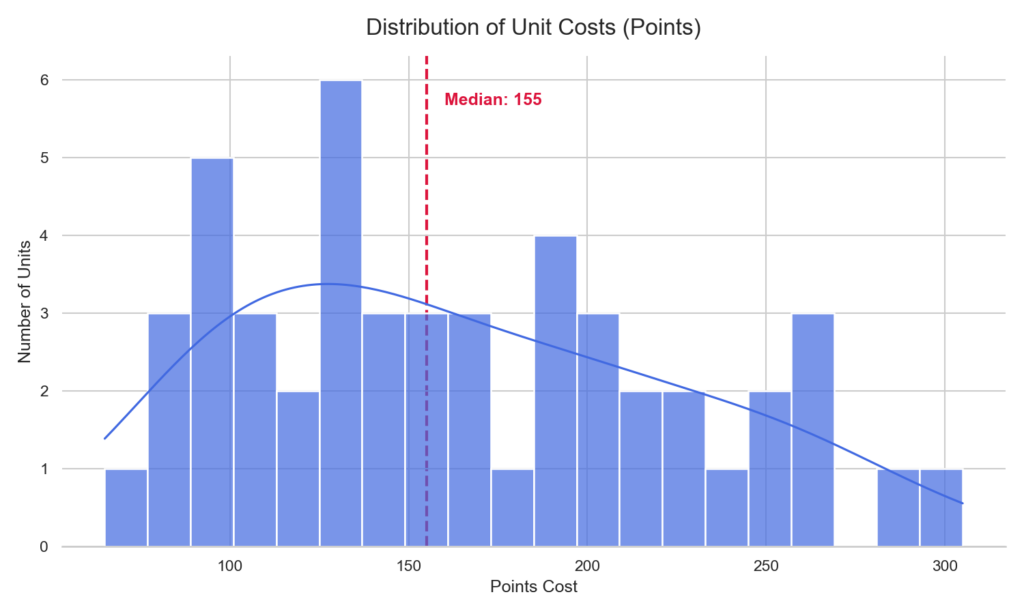
| Avg Points | 164.8 | 156.9 | +7.9 |
| Avg Defense | 4.6 | 4.3 | +0.3 |
| Avg Speed | 6.2 | 6.3 | -0.1 |
| Top Keyword | Crushing Strength | – | – |
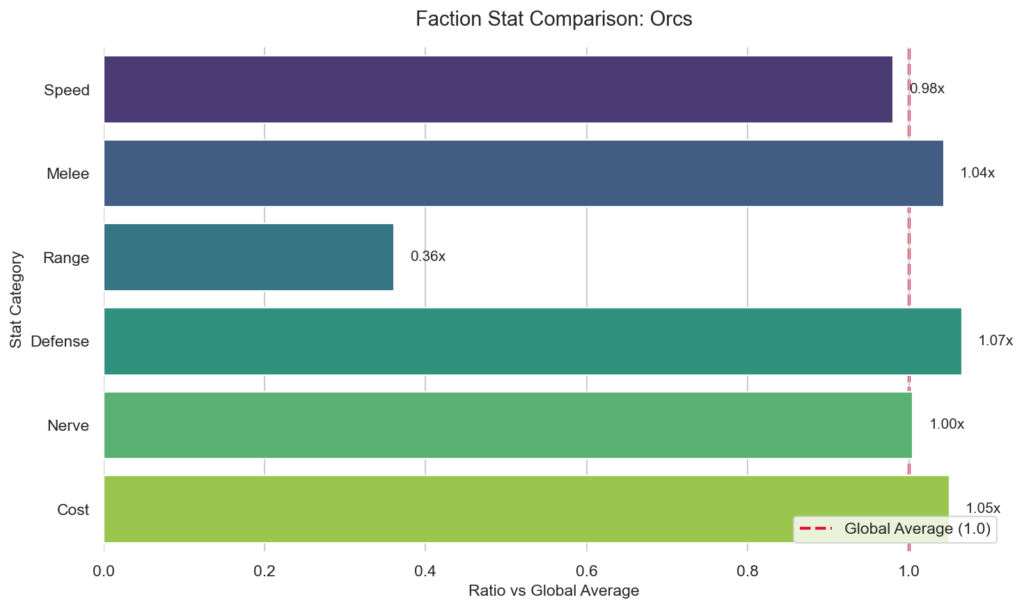
Orcs pay more than the field average to buy sturdier statlines, not more speed. That is the first useful read. This is not a fast finesse army hiding behind a green paint job. It is a mid-board combat army with slightly above-average Defense, average movement, and a faction identity tied heavily to Crushing Strength.
That profile gives Orcs a clear job: take space, force contact, and trade through the middle of the table. The faction is not naturally loaded with shooting, not especially nimble, and not built around avoidance. It wants to be close enough that every deployment mistake matters.
The historical tournament sample points the same way. Average Orc lists scaled to 2300 points run 13.7 units, 13.5 scoring units, only 42.8 points in items, and just 6.1 ranged attacks. They average 176.5 total attacks, 215.7 total nerve, and 347.1 shots to reach six nerve.
That is a very clear army shape: bodies, nerve, combat volume, and very little nonsense.
Most Cost-Effective Units
| Unit Name, Size | Shots to 6 Nerve | Avg Hits | Points | Elo | Cost Effectiveness | % Kills vs Def 4 | % Kills vs Def 5 |
| Orclings, Regiment | 15 | 8.0 | 90 | 1361 | 1.76 | 13.2% | 0.2% |
| Greatax, Regiment | 20 | 8.1 | 130 | 1685 | 1.30 | 40.1% | 4.3% |
| Riftforged Legionaries, Regiment | 30 | 8.0 | 135 | 1715 | 1.23 | 23.6% | 0.7% |
| Riftforged Legionaries, Troop | 18 | 6.7 | 105 | 1361 | 1.18 | 15.6% | 0.4% |
| Reborn Legionaries, Troop | 21 | 6.6 | 135 | 1646 | 1.15 | 24.3% | 1.5% |
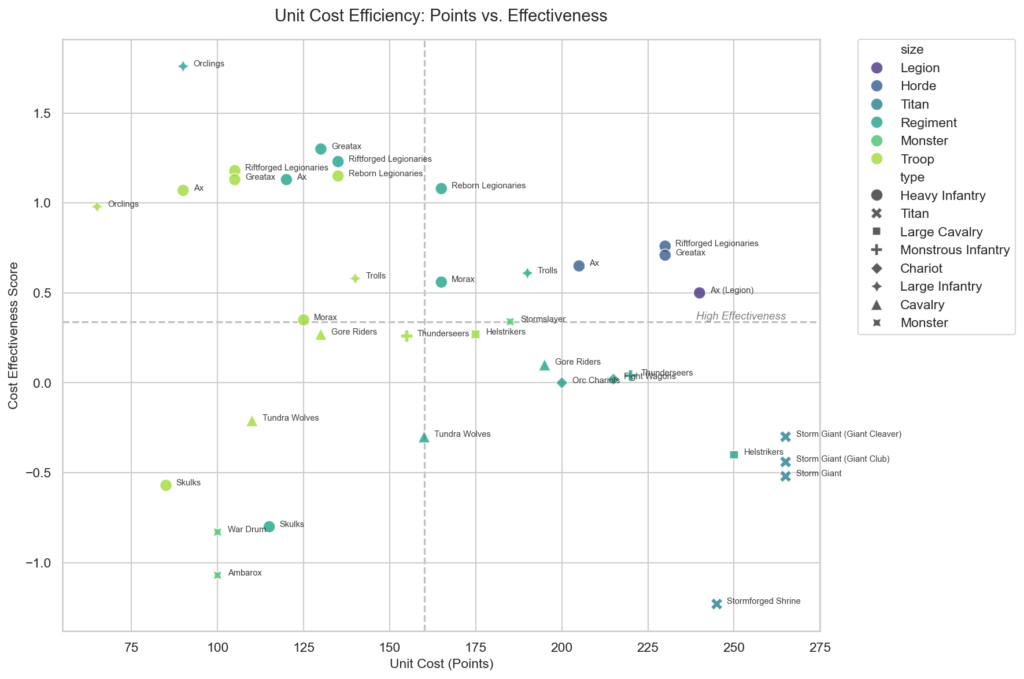
The top of the efficiency table tells the Orc story almost by itself. The three units that matter most are:
- Orclings Regiment: cheap control and scenario presence.
- Greatax Regiment: the cleanest efficient damage buy.
- Riftforged Legionaries Regiment: the best honest line-holder in the efficient band.
The next two entries matter too. Riftforged Legionaries Troops keep Auxiliary slots useful, and Reborn Legionaries Troops give the army a compact Specialist threat that does not completely break the spending curve.
The hidden pattern is armor math. Across these five units, the average one-round kill rate is much better into Def 4 than Def 5. Even Greatax, the standout damage piece, only shows a 4.3% one-round kill chance into Def 5. That does not mean the unit is bad. It means Orc efficiency is not about clean deletion into hard armor. It is about sequencing: You hit first. You survive the reply. Then the next unit finishes the job. Sticky combat plays into your strengths here, as you lock down an opponent and prevent them from going elsewhere.
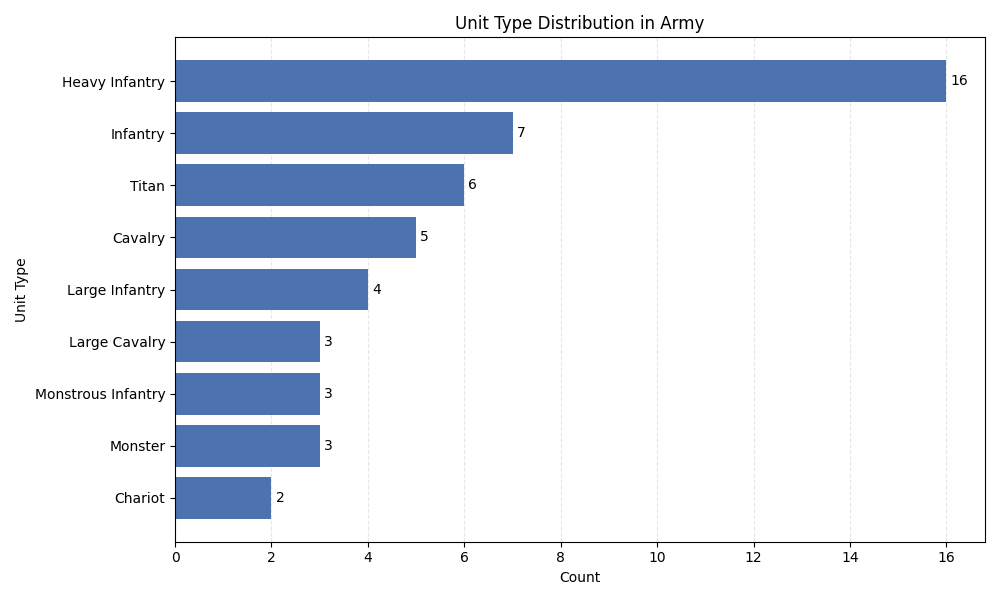
What is missing is just as important. The top tier is not full of monsters, elite cavalry, expensive heroes, chariots, or shooting pieces. The best Orc value sits in low-to-mid cost infantry and control bodies.
That has real list-building implications. The 4E battalion system mostly helps Orcs because the faction’s best pieces already live in the Core and Auxiliary lanes. Greatax and Riftforged Legionaries are exactly the sort of units you want to repeat. Orclings are exactly the sort of cheap support piece that makes those Core choices work.
The pressure starts when you chase too many premium pieces. Reborn Legionaries, Trolls, Thunderseers, Fight Wagons, Helstrikers, the War Drum, the Shrine, Ambarox, Stormslayer, and giants all compete for limited list space. Some of those pieces are good. The problem is not quality. The problem is opportunity cost.
Unit Deep Dives
Orclings Regiment
Role: chaff, scoring, control.
Orclings are not glamorous. That is the point.
At 90 points with 15 shots to six nerve, Orclings are the cheapest reliable way to buy time and board space in the faction. They screen Greatax. They absorb bad angles. They sit in the way of expensive enemy pieces. They keep your real units from being forced into ugly charges. Orcs are not a deep nimble-control army. They need to create board control with bodies more than pivots. Orclings give them that body count without pulling points away from the main combat line. The math is clear about the caveat. A 13.2% kill chance into Def 4 and 0.2% into Def 5 means they are not a budget hammer. They are there to make your good units better, not to be good units by themselves. Use them to protect the trade. Do not use them to make the trade.
Greatax Regiment
Role: trade hammer.
Greatax are the cleanest offensive regiment in the efficient band. At 130 points, they bring enough output to threaten medium armor without becoming a centerpiece. That is exactly where Orcs want to live. The key number is the 40.1% kill rate into Def 4. That is not automatic, but it is real. It means Greatax punish damaged units, exposed medium infantry, fragile scoring pieces, and opponents who assume Orc infantry is only there to grind.
They also scale well with command support. Green Rage is best on units that already throw meaningful attack volume, and Greatax fit that job. The unit does not need to become spectacular. It just needs a small spike at the right time. The caveat is target discipline. Greatax are much less convincing into Def 5, and 20 shots to six nerve means they do not love being left in the open after they hit. They are a trade hammer, not a solo problem solver. Send them into the right target and they look undercosted. Send them into the wrong one and they look very average.
Riftforged Legionaries Regiment
Role: anvil, scoring anchor, main line block.
Riftforged Legionaries are the faction’s best honest line unit in the top efficiency tier. They are not here to do tricks. They are here to stand in the middle of the table and make your opponent spend real resources to move them. The 30 shots to six nerve number is the big deal. That is the best durability profile in the top group, and it comes on a unit that still holds a strong 1.23 cost-effectiveness score. For an army that wants to play the mid-board, that is exactly the kind of profile you can build around. On the table, this is the regiment you trust. It scores, absorbs pressure, and keeps the army’s shape intact. It also fits the battalion system cleanly, which matters more than people sometimes admit. A good Core unit is not just a good unit. It is a good list-building foundation.
The risk is that Legionaries are honest. They do not magically solve Def 5. Their 23.6% kill rate into Def 4 is useful, but their 0.7% into Def 5 is a warning label. They hold the lane better than they finish the lane. They need support, follow-up, or a favorable double-charge to cash in.
Trap Units
Thonar
My hot take after looking at the math: Thonar is the easiest Orc trap because he flatters the player.
The appeal is obvious. His version of Green Rage improves the spike potential of your combat units, and that sounds like exactly what Orcs want. In the right build, that can be true. The problem is cost and certainty. Thonar asks you to pay premium points for a force multiplier. That means the rest of the list has to be built to extract that value. If he is supporting several high-attack Orc or Forged units and helping convert one decisive turn, he has a job. If he is just there because he looks like the faction’s strongest character, he is probably draining points from the line. What beats him for fewer points is not another shiny hero. It is more bodies. Another efficient regiment plus a cheaper command package often gives you a steadier tournament return. (And, for what it’s worth, this is why, despite all the handwringing, I don’t see Orcs running away with unstoppable winning percentages).
How to use him well: build the list around his order value. Do not splash him into a list that is already light on scoring, chaff, or line depth.
Helstrikers
Helstrikers look like the premium answer piece. Fast. Elite. Dangerous. Stylish. That is exactly why they are dangerous in list building. The issue is the double tax. First, you pay for a premium mobile hitter in an edition that already prices speed and elite cavalry carefully. Second, you pay the opportunity cost of the slot. In Orcs, the premium lanes are crowded. Every expensive support or specialist choice competes with the boring units that actually make the army function.
Greatax and Riftforged Legionaries do not look as exciting, but they give cleaner battalion flow, better board presence, and more repeatability. A single Helstriker-style piece can make sense as an exploit tool. A list built around too many premium pieces usually starts to lose the Orc advantage.
How to use them well: take one if it solves a specific problem. Do not start the list there.
Strategic Archetypes
Historical Tournament Tendencies
The 16-list historical sample is small, so I would not overclaim from it. But it is still useful.
Average Orc lists scaled to 2300 points show a very clear profile:
- 13.7 units
- 13.5 scoring units
- 42.8 points in items
- 6.0 average speed
- 4.6 average defense
- 215.7 total nerve
- 347.1 shots to reach six nerve
- 176.5 total attacks
- 6.1 ranged attacks
That is not a faction hiding power in upgrades. It is not a shooting army. It is not a finesse toolbox. It is a scoring-dense melee army with enough nerve to stay relevant after the first clash. The cluster analysis also matters. Two of the three archetypes are labeled Balanced, and together they make up 93.8% of the sample. The pure Grind build exists, but it is rare. That suggests competitive Orcs are not solving the edition through one gimmick. They are mixing pressure, durability, and scoring density.
Archetype 1: Efficient Infantry Pressure
Core idea: build around the efficient shell and use orders to amplify already-good trades.
What you spam: Riftforged Legionaries, Greatax, Orclings, and selective Reborn troops.
How you win games: you create a stable line, force contact on your terms, and trade up through repeated mid-cost pressure.
This is the cleanest Orc plan. You buy the good Core units, protect them with cheap control, and avoid overloading the list with expensive pieces that do not help the main plan. The army does not need to table people. It needs to make every exchange slightly awkward for the opponent. Once that starts happening, Orcs get better as the game goes on because their scoring density keeps mattering.
Archetype 2: Threat-Extension Orcs
Core idea: lean harder into classic Orc pieces and make the opponent respect fake-safe distances.
What you spam: Ax, Greatax, Morax, Gore Chariots or Fight Wagons, plus a War Drum or command support.
How you win games: you distort the charge map. Your opponent has to respect the order spike, not just your printed Speed.
This build is less about raw efficiency and more about movement pressure. It asks a simple question: can the opponent stage correctly when your threat range is not fully stable? That uncertainty is useful. Players often lose games by standing half an inch too close. Orcs can punish that. The risk is that this build can become too cute. If the list is all threat and no second wave, a failed charge turn or bad order roll can leave you exposed. Threat projection is strongest when it sits on top of a solid infantry shell.
Archetype 3: Selective Grind
Core idea: accept that you are a scenario brick and build accordingly.
What you spam: Ax bricks, Riftforged bricks, scoring bodies, and a small number of utility anchors.
How you win games: you refuse to die fast enough and make the scenario math ugly.
This is the rarest archetype in the sample, but it has a logic. Orcs can build a lot of total nerve and unit strength. If you lean into that, the opponent has to physically remove you from the table instead of just outmaneuvering you. The danger is recovery. Grind lists can be very hard to beat when they deploy well and maintain formation. They can also feel clumsy when they misdeploy or lose the first real exchange. With limited shooting and modest speed, the list does not always have a clean way to fix early mistakes.
Verdict
Orcs in 4E are broader than they look and narrower than they feel.
The merged roster gives the faction a lot of choice, and the command orders are real. But the best Orc lists are not built by sampling the whole buffet. They are built by taking the efficient shell seriously, then adding only the premium pieces that solve a specific table problem. The data points to a simple identity: scoring bodies, durable infantry, medium-armor punishment, and order-driven pressure.
Strengths
- Cheap control and scoring density let Orcs play the board without sacrificing combat output.
- Core and heavy infantry are strong places to spend points in 4E, and Orcs have several good options there.
- Command orders create real tactical spikes in either hit volume or charge threat.
Weaknesses
- The top efficiency band is much better into Def 4 than true hard targets.
- The faction has many attractive premium choices competing for crowded list-building lanes.
- Orcs can look powerful on paper while still underperforming if the list overspends on toys.
Final advice: Stop buying Orcs to feel powerful and start buying them to trade efficiently.
4th Edition Resources and Further Reading
- Goonhammer Orcs Army Preview — Useful public walkthrough of the merged Orc and Riftforged roster, slot categories, and command orders.
- Data & Dice Adepticon 2026 recap — Useful event-context piece for Orc popularity and early tournament conversion.
- Master Sight Orc army review video — Short 4E video overview of Orc units and command orders.
- Kings of War forum Orcs in 4th thread — Useful player discussion around early 4E Orc shells and command-order pressure.
- Regnum Aeternum — regular battle reports involving Orcs.