Elves in 4th Edition are not a glass cannon army: they are a reliability engine.
On paper, Elves are fast, precise, and built around the Elite keyword. The expectation is clean spikes and ranged dominance. The data says something different. Across your simulation set and efficiency model, the units that actually overperform are mid-cost infantry blocks, not drakons, not heavy cavalry, not massed shooting.
Elves win in 4E by stacking efficient infantry, controlling the mid-board, and forcing favorable trades. Speed lets you choose fights. Elite smooths variance. But raw durability is average, and shooting does not close games on its own. In other words, build Elves to trade consistently and control space. If your plan depends on deleting units in one activation, you are fighting your own math.
Data Snapshot
| Statistic | Elves Avg | Global Avg | Delta |
|---|---|---|---|
| Avg Points | 162.44 | 156.88 | +5.56 |
| Avg Defense | 4.30 | 4.31 | -0.01 |
| Avg Speed | 6.95 | 6.31 | +0.64 |
| Top Keyword | Elite | – | – |
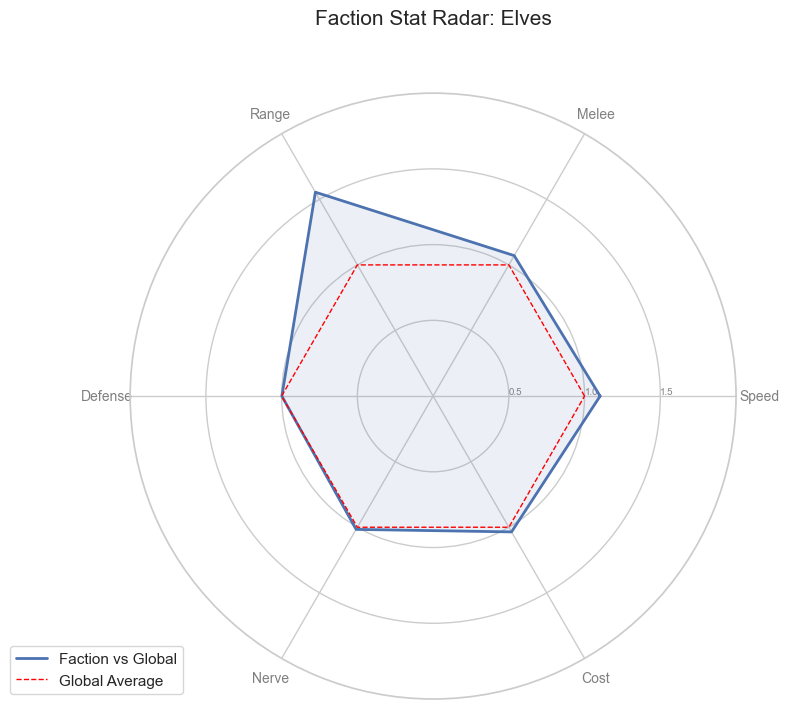
This radar highlights the core truth: above-average speed, average durability, and strong consistency via Elite.
What This Means
Elves are faster than the field, but they are not tougher than the field. Their identity is reliability, not explosiveness. The army plays best when it controls engagement timing rather than trying to stat-check opponents.
Most Cost-Effective Units
| Unit | Size | Category | Pts | Key Rules | Efficiency |
|---|---|---|---|---|---|
| Kindred Tallspears | Regiment | Core | 120 | Elite, Phalanx | 1.18 |
| Hunters of the Wild | Regiment | Auxiliary | 110 | Scout, Pathfinder | 1.13 |
| Palace Guard | Troop | Auxiliary | 125 | CS(1), Elite | 1.01 |
| Kindred Tallspears | Troop | Auxiliary | 95 | Elite | 0.91 |
| Critters | Troop | Auxiliary | 65 | Fly, Pathfinder | 0.88 |
| Palace Guard | Regiment | Core | 160 | CS(1), Elite | 0.87 |
Points vs Efficiency Score. Most Elves cluster under 200 points. Almost every top performer is infantry.
Patterns
- The top tier is overwhelmingly Core and Auxiliary infantry.
- Elite + efficient cost = reliable trades.
- Expensive monsters, archers, and cavalry do not appear in the top band.
Battalion Impact
4E battalion rules reward exactly what the math already favors. Core infantry unlock Aux and Specialists, and your best units are Core infantry. The structure pushes you toward the optimal build naturally. What is missing from the top tier?
- Drakons
- Heavy cavalry
- Large archer formations
- High-cost heroes
That absence is the story.
Unit Deep Dives
Kindred Tallspears (Regiment)
Role: Anvil / Line Holder
Mean wounds vs De5: ~2.9
Cheap, Elite, and Phalanx make this one of the most efficient defensive regiments in the book. They do not spike damage, but they grind consistently and trade well into similar-cost infantry.
Risk: No Crushing Strength, so they may need Bane Chant support. They stall heavy armor rather than breaking it.
Hunters of the Wild (Regiment)
Role: Trade Piece / Early Pressure
Mean wounds vs De5: ~3.3
Scout plus 3+ melee output means they punch above expectations on turn one. They create early board stress and force reactions.
Risk: Low nerve. If unsupported, they disappear fast.
Forest Shamblers (Regiment)
Role: Objective Anchor
Mean wounds vs De5: ~4.0
They quietly outperform expectations in sustained combat. Fearless keeps them stable. Crushing Strength gives them real bite.
Risk: Shambling positioning mistakes are punished.
Trap Units
Kindred Archers (Horde)
They feel powerful. They are not efficient. Simulations show roughly 2.6 wounds on average into De5. Shooting cannot rout a healthy unit. That means suppression, not removal. Archers are setup tools. They are not a primary damage engine.
Silverbreeze Cavalry
Fast. Flexible. Expensive. Simulation output is modest both at range and in melee. You are paying for mobility, not efficiency. Into infantry-heavy builds, they trade poorly for cost. They are playable. They are not optimal.
Strategic Archetypes
1. Scout Pressure Build
This build leans hard into Hunters of the Wild, Critters, and other fast Aux pieces that can project pressure immediately. Scout deployments and above-average speed let you contest space before slower armies are fully set. The goal is not raw damage—it is tempo. You force awkward early charges, pull opponents off ideal lanes, and threaten flanks from turn one.
You win by scoring early, creating uneven trades, and making your opponent fight on your timeline. If they commit too soon, you collapse on isolated units. If they hesitate, you accumulate scenario points and board control. This archetype rewards precise spacing and disciplined withdrawals.
2. Softening + Finish
This build runs a restrained shooting package—just enough to chip key targets and set up decisive charges. A small block of archers, Sea Guard, or a bolt thrower provides suppression, forcing Wavers or shaving nerve before melee begins. Shooting is not the primary kill mechanism but preparation.
Once a target is softened, Elite infantry (i.e. Palace Guard) delivers the actual removal. The focus is sequencing: shoot first to reduce counterpunch risk, then commit reliable melee blocks to finish. You win by combining modest ranged pressure with mathematically efficient close combat rather than overinvesting in either.
Verdict
Elves have three clear strengths. First, they produce remarkably reliable combat output. Elite saturation smooths variance across multiple units, which matters in a system where combats can grind for several turns. You are less dependent on spikes and more able to plan around expected outcomes. Second, their above-average mobility lets them dictate engagement timing. Speed is not just about charges; it is about angles, threat ranges, and repositioning after trades. Third, their most efficient units are Core infantry, which aligns perfectly with 4E battalion structure. You are rewarded for taking the very units your math already favors.
Their weaknesses are just as clear. Durability is average across the faction, which means you cannot afford careless exposures or isolated fights. Shooting, while useful for setup, does not close games on its own under 4E’s mechanics. Finally, many expensive units—monsters, large cavalry blocks, premium characters—underperform relative to their cost. When you overinvest in them, you reduce the density of efficient infantry that actually wins you trades.
Final Advice
Build around your most efficient infantry. Use speed to choose fights. Stop trying to delete units in one turn.
4th Edition Resources
- Kasual1414’s Youtube channel, which has many 4E Elf battle reports
- KOWForum thread on Elves in 4E