In Part I, I looked at compression in the 2026 US Masters field: fewer faction labels, a higher top-four faction share, and a much tighter magic item spread. This second pass looks more at what the lists are trying to do on the table. The short version is that the 2026 field looks more dangerous in combat, but shooting has not gone away. Average ranged attacks are down from the prior Masters fields, but Gun Line is still the largest listed archetype in the 2026 report. That makes this a useful follow-up to Is Shooting Dead in Kings of War 4th Edition? The Data Says Not Quite.
That article argued that 4E shooting looked lower, narrower, and less dependable than 3E shooting, while still being very much alive when it had a clear job. The US Masters field fits that pattern pretty well. Shooting is not spread evenly across the field but is concentrated in specific armies and archetypes, especially Elves, Goblins, and Ratkin. The useful question is whether those lists are bringing enough board control to make the shooting matter.
TL;DR
The 2026 US Masters field is hitting harder than the 2024 and 2025 fields. Average expected damage and total attacks are both up sharply, even while average ranged attacks are down. Goblins are the clearest stress test because they bring extreme unit count, Unit Strength, nerve, and shooting. Gun Line is the largest archetype, but the strongest shooting lists are not just trying to win by damage. They are trying to flood the board, score, and force opponents to solve too many problems at once.
Footnote on archetypes: These labels are useful shorthand, but they are not exact categories. In practice, they are closer to a spectrum than a set of clean buckets. For example, Corey Reynolds’ Ratkin list sits at 25 ranged attacks. That is not an obvious “gunline” by feel, but across a dataset of 1,000+ 4E lists it lands around the 80th–85th percentile for shooting. That is enough to push it into the Gun Line bucket for classification purposes, even if it plays more like a mixed-arms list on the table. In other words, some of these labels are part data and part judgment.
The dataset
This article uses the pre-tournament reports from the 2024, 2025, and 2026 US Masters fields. Small sample warning applies here. These are list-level metrics from one event each year, not game results. There is also an edition-change warning. The 2026 event is Fourth Edition, while the 2024 and 2025 fields were Third Edition. Some list-building incentives changed. Some faction labels changed. Some army tools changed. So I would use the year-to-year numbers as a field-shape comparison, not as a perfect edition-to-edition lab test. That said, Masters is still useful. The event is large enough to show patterns, and the players are generally serious enough that their list choices deserve attention.
4E lists are hitting harder
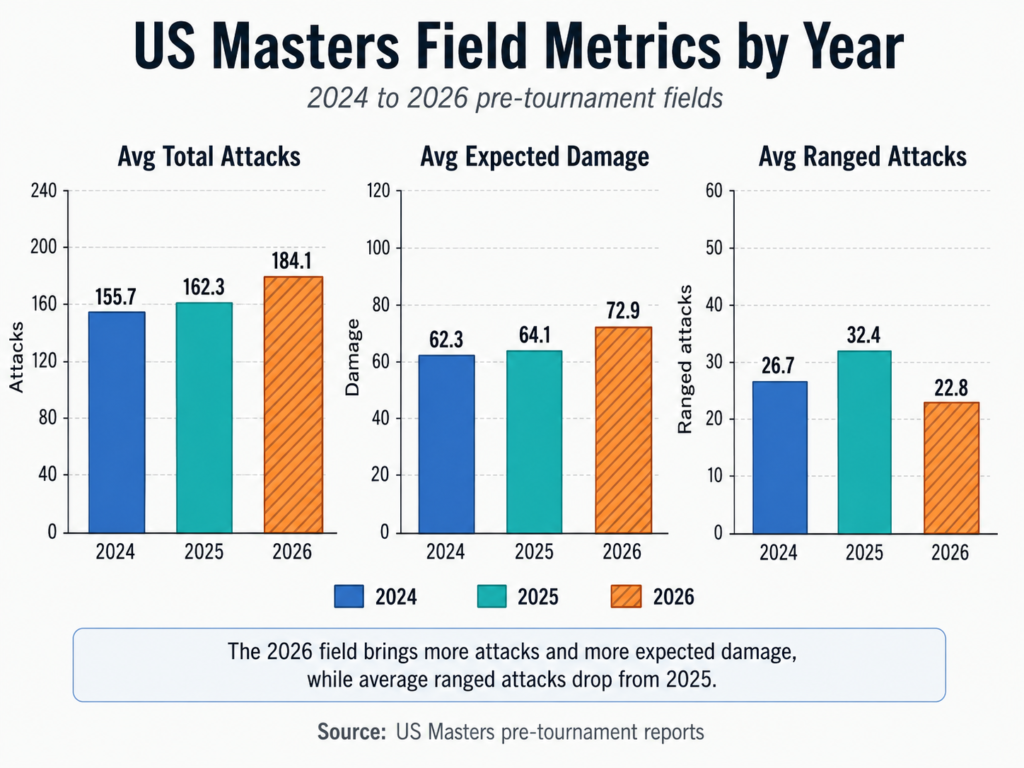
The first broad signal is damage: The average 2026 list has 184.1 total attacks, up from 162.3 in 2025 and 155.7 in 2024. Expected damage also rises, from 62.3 in 2024 and 64.1 in 2025 to 72.9 in 2026. That is a 13.7% increase in expected damage from 2025 to 2026, and a 17.0% increase from 2024 to 2026. Total attacks show a similar move. My theory is that sticky combat plus limiting charges to two per facing have put a premium on quickly taking down enemy units, thus increasing the value of “Gladiator” hammers.
The ranged attack number moves the other direction. The 2026 field averages 22.8 ranged attacks, down from 32.4 in 2025 and 26.7 in 2024.
The combination is the useful part. The 2026 field is not simply more aggressive because everyone brought more shooting. The damage appears to be coming more from melee density, mixed arms, and lists that can trade harder once the lines meet. For players, that probably means the average matchup will punish soft trades more quickly. A list that could survive a loose early exchange in 2025 may have a harder time doing that here. There are more attacks on the table, more expected damage, and more bodies behind it.
The practical question is less “can my list kill things?” and more “can my list keep scoring after the first real trade?”
The Goblin stress test
Goblins are the cleanest example of the second question. There are five Goblin lists in the 2026 field. All five are tagged as Gun Line. More importantly, they are extreme on the metrics that matter for scenario pressure. The Goblin profile is not built around top-end expected damage. Their expected damage is slightly below the field average. Rather, the pressure comes from everything around the damage.
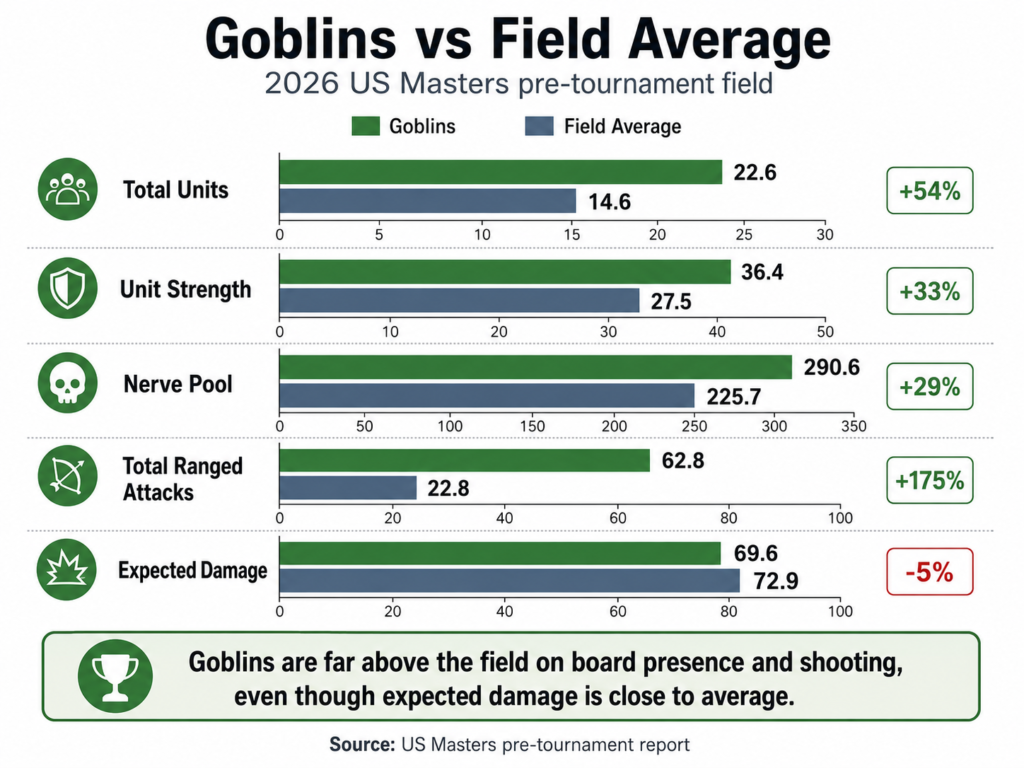
Goblins average 22.6 total units. The field average is 14.6. They average 36.4 Unit Strength against a field average of 27.5. Their nerve pool is 290.6, well above the field’s 225.7. Their ranged attacks are almost three times the field average. That is the stress test.
Can your list remove enough bodies before the game ends? Can it do that while taking shooting pressure? Can it avoid wasting premium damage into cheap or awkward targets? Can it win the scenario without getting dragged into every corner of the board?
Goblins make those questions very concrete. The outlier report also flags how far some of these lists go. Travis Timm has 28 total units, 42 Unit Strength, and 344 nerve. Dustin Howard has 26 total units and 317 nerve. Those are not normal list profiles. They create games where “I killed a lot” may still be a losing sentence if the wrong things are alive on turn six.
That is why Goblins are the faction I would watch first for scenario pressure. They may not end up winning the event. They may run into bad matchups or players who have clean answers. But if the field cannot answer board saturation, Goblins will expose that quickly.
Shooting is narrower, not gone
The earlier shooting article argued that 4E shooting had moved away from being a default army-building pillar. The 2026 US Masters field supports that read. Average ranged attacks are down from 2025. The field as a whole is not bringing more shooting. But the shooting that does show up is concentrated and intentional. Gun Line lists make up 34.4% of the field, but they account for about 78% of all ranged attacks in the event. That is a strong concentration signal.
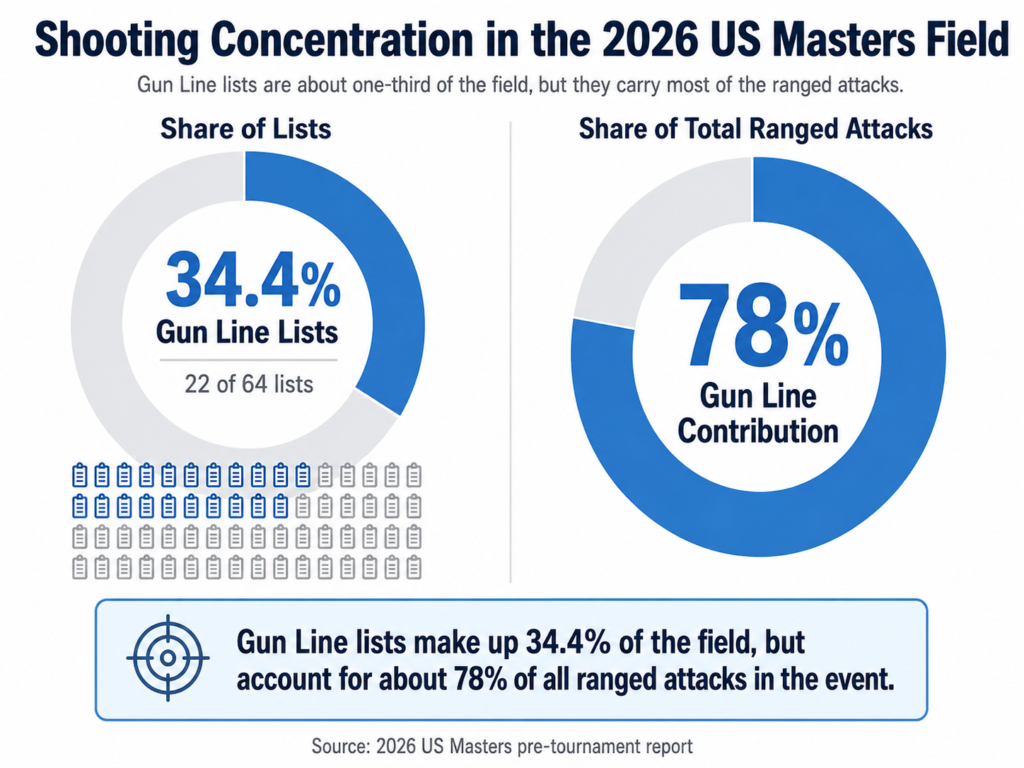
That is probably the right way to think about shooting in this field. It is not dead. It is not everywhere. It is concentrated in lists that have a clear plan for it.
Elves are the cleanest traditional version of that plan, with six of seven lists tagged as Gun Line and an average of 51.7 ranged attacks across the faction. Goblins are the board saturation version. Ratkin are the pressure version, with all four lists tagged as Gun Line and strong Unit Strength behind the ranged output. Those are different problems.
A list that can handle Elven shooting may still struggle into 28 Goblin units. A list that can grind through Goblins may still dislike Ratkin pressure. The common thread is that shooting is being used to support a larger table plan.
What I would watch at Masters
The post-event results should tell us which of these signals mattered. The first question is whether Goblins convert the stress test into wins. If Goblins put multiple players in the top half, that says a lot about early 4E scenario pressure. If the faction falls back, the field may already have enough tools to clear cheap units and manage board saturation.
The second question is whether the harder-hitting lists actually perform better. The 2026 field has more total attacks and more expected damage than the prior two Masters fields, but pre-event output does not always translate into wins. Delivery, timing, scenario play, and matchup spread still decide games.
For players, my prep note would be simple: bring a plan for saturation, bring a plan for concentrated shooting, and do not assume that lower average ranged attacks means shooting will not shape your games.
The 2026 US Masters field is not just compressed. It is also asking sharper table questions than the prior two fields: Can you clear enough bodies? Can you survive the first real trade? Can you cross the board into shooting without losing the scenario on the way in?
That is what I will be watching when the results come in.