Introduction
Kings of War players love to debate balance. A faction wins a tournament and suddenly it’s “too strong.” A unit spikes damage in one game and it becomes “broken.” A local meta leans a certain way and people assume the entire game works like that. The problem is that most of these conversations are built on very small samples.
So over the past year I started building something I wish existed for the community: a clean dataset of real Kings of War games that we can actually analyze. Right now the tracker contains about 1,100 games from 4th Edition. Each record includes faction, matchup, list composition, and other attributes that let us explore what actually drives results on the table. The result is the Data & Dice Kings of War Dataset Explorer:
Instead of arguing from anecdotes, we can finally start asking questions like:
- Are some factions actually overperforming?
- Do certain list structures win more often?
- Do stats like Defense or Speed correlate with results?
Below I’ll walk through a few of the tools in the explorer and what the early data suggests.
Faction Win Rates
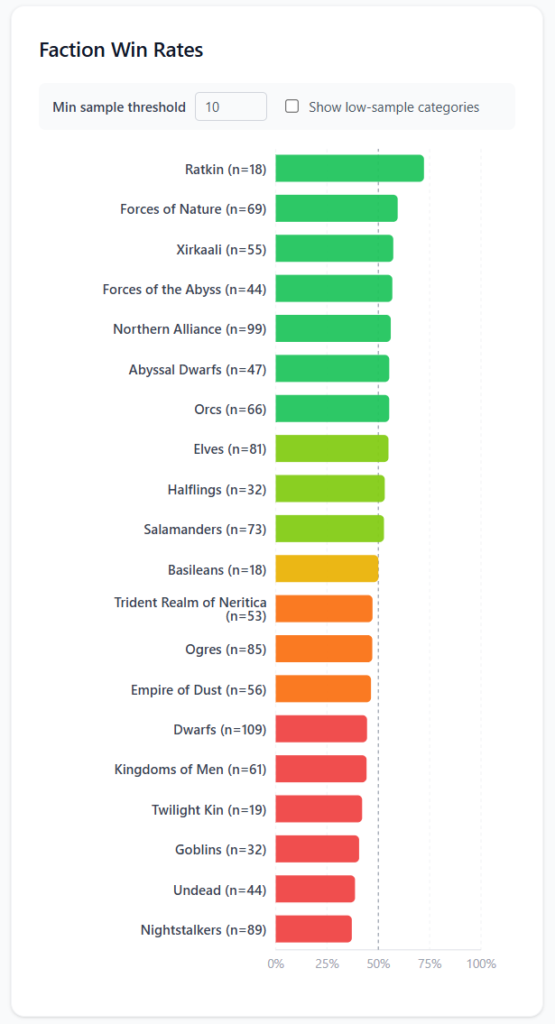
The first place most players look is faction performance. With more than a thousand recorded games, faction win rates start to stabilize. The noise from small tournaments fades and we can see broader trends.
What the data shows so far is interesting: most factions cluster surprisingly close together. There are small differences, of course. Some factions run a little hot. Others sit slightly below average. But the overall spread is far tighter than many online discussions would suggest. That’s an encouraging signal for the game overall.
If this dataset reflects the broader competitive environment, 4th Edition balance appears healthier than many players assume.
Archetype Performance
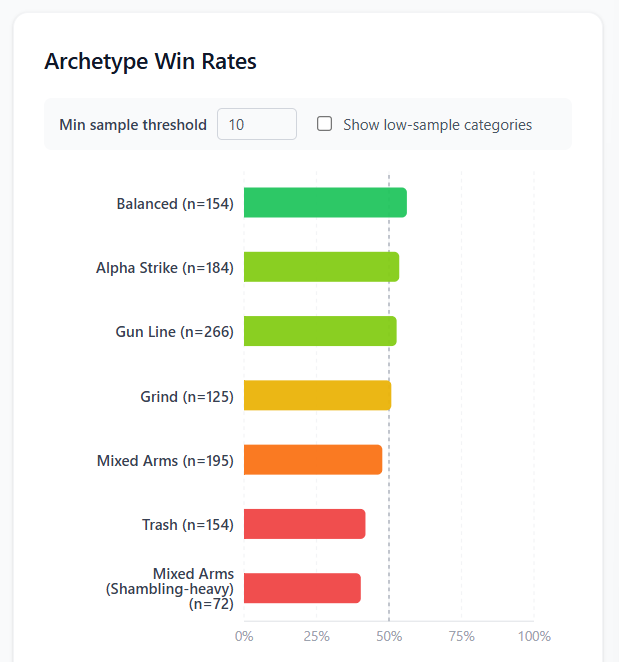
The dataset also categorizes armies by broad archetype. This lets us ask a more interesting question: does playstyle matter more than faction?
Early results suggest it might. Certain list structures consistently perform above average regardless of faction. Others tend to struggle even when attached to strong armies. This doesn’t mean any specific archetype is “solved” or dominant.
But it does suggest that list construction decisions may matter more than faction choice itself. For competitive players, that’s useful information.
The Stat Explorer
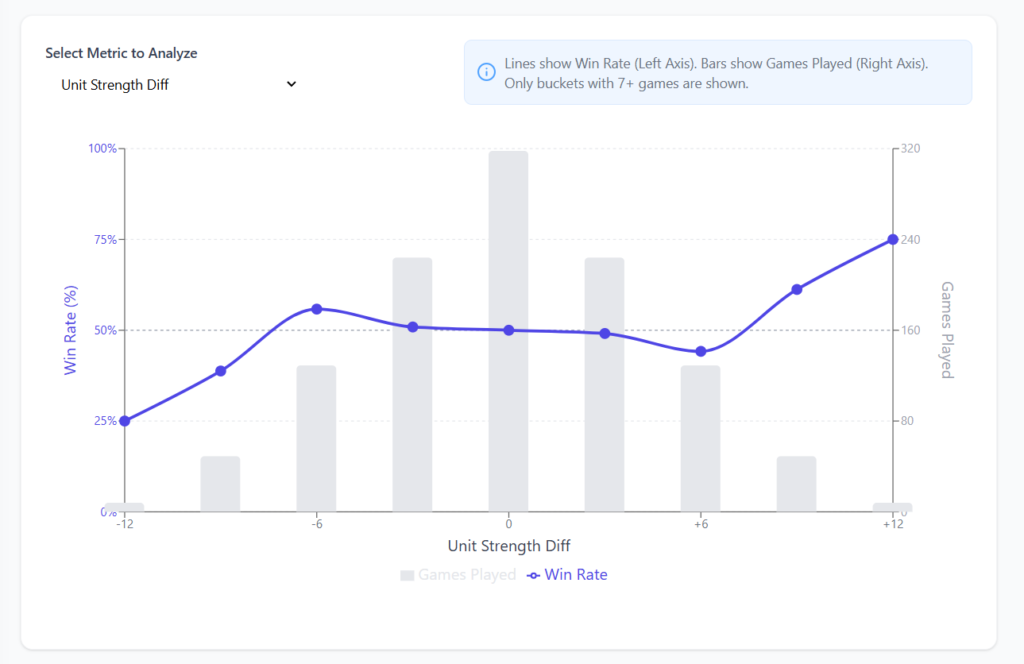
The feature I’m personally most excited about is the Stat Explorer. This tool lets you explore whether certain army characteristics correlate with better results. For example, you can test whether armies with:
- Higher average Defense
- Greater Speed
- More attacks
- Larger unit counts
actually perform better across hundreds of games.
The early answer is somewhat surprising: very few individual stats strongly predict success. There are trends, but no obvious “silver bullet” stat that guarantees better results. That lines up with what many experienced players already suspect: Kings of War is still primarily a positioning and scenario game. Good play matters more than any single stat profile.
Composition Comparison
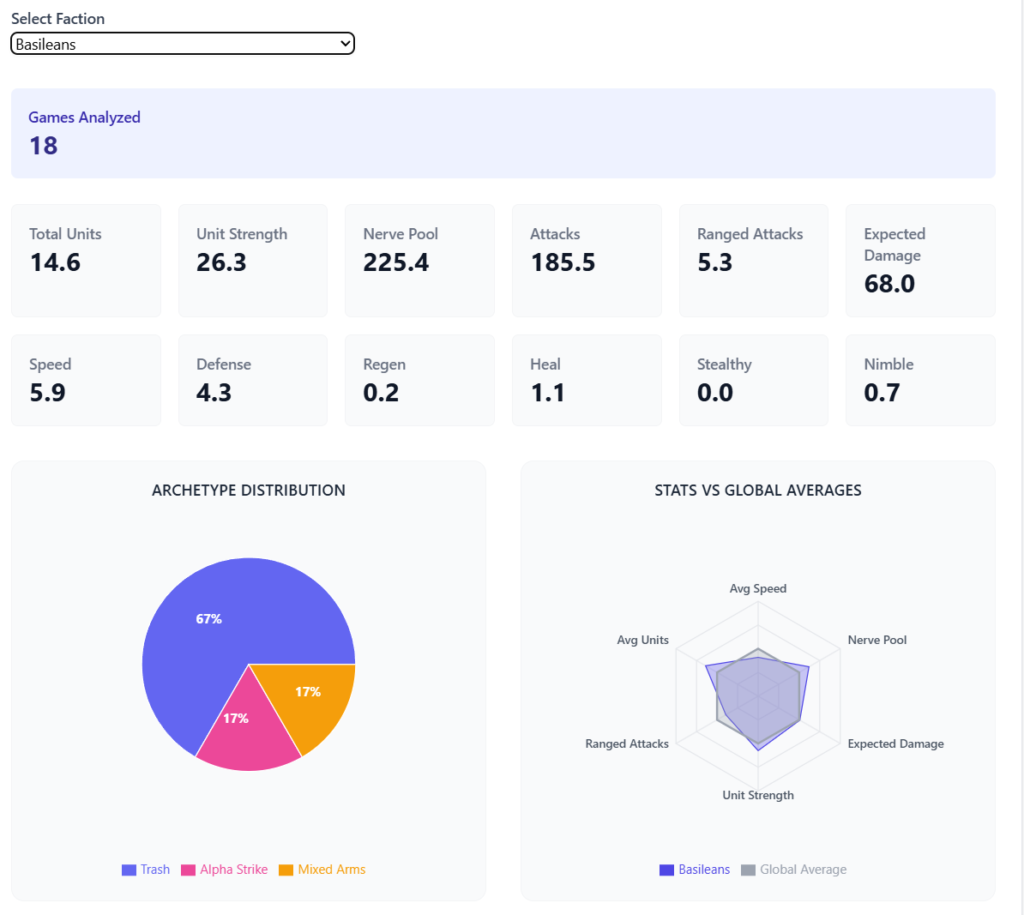
The final major feature in the explorer is the composition comparison tool. This allows players to compare their army structure against thousands of lists already recorded in the dataset. It answers questions like:
- Is my list typical for this faction?
- Am I running more monsters or heroes than most players?
- How similar is my army to what the field usually brings?
For tournament preparation, this can be incredibly useful. Instead of guessing what “normal” looks like, you can actually see where your list sits relative to the broader meta.
Why This Matters
Competitive games benefit enormously from good data. Magic has large statistical communities. Chess has centuries of recorded games. Even many video games publish massive performance datasets. Tabletop miniature games historically haven’t had that kind of infrastructure. Projects like this help move the conversation forward. The goal isn’t to declare final answers or prove anyone wrong. It’s simply to make better questions possible.
When discussions move away from anecdotes and toward real evidence, the entire competitive community benefits.
Where This Goes Next
The dataset is still growing. More games mean better confidence in the patterns we’re starting to see. Future updates will likely include:
- Matchup analysis between factions
- Player skill adjustments
- Event-level meta trends
- More detailed list construction metrics
If you want to explore the data yourself, start here: https://kow-dataset.web.app
And if you have event data available, consider contributing. I’m particularly looking for events where we have: lists for all players and game-by-game results. You can reach out or share datasets through the forum thread here: https://www.kowforum.com/t/data-and-dice/4354
More data makes the project better for everyone. So if you’re a TO or someone who tracks events, I’d love to hear from you.
TL;DR:
The Data & Dice dataset now includes over 1,100 Kings of War 4th Edition games. Early analysis suggests faction balance is tighter than many players expect, list structure may matter more than faction choice, and individual army stats are weaker predictors of success than positioning and scenario play.