Thirty-two players. Seventeen factions. Three very different ways to fill the table with Goblins. And my sixth post of September, which might be a monthly record.
The 2026 Ohio GT lists are in, and the field has more variety than any one faction count suggests. There are 32 armies at 2,300 points across 17 factions. Northern Alliance leads with four entries; Goblins, Undead, and Trident Realm each have three. Nobody occupies more than an eighth of the field. If you just want the overly detailed data dump, here you go:
The first thing I noticed was the number of bodies. The three Goblin players bring 21, 21, and 25 units. If a game comes down to holding ground on the last turn, that matters more than an impressive damage total on a spreadsheet. Here are the questions I will be watching when dice hit the table.
A broad field with a Goblin problem
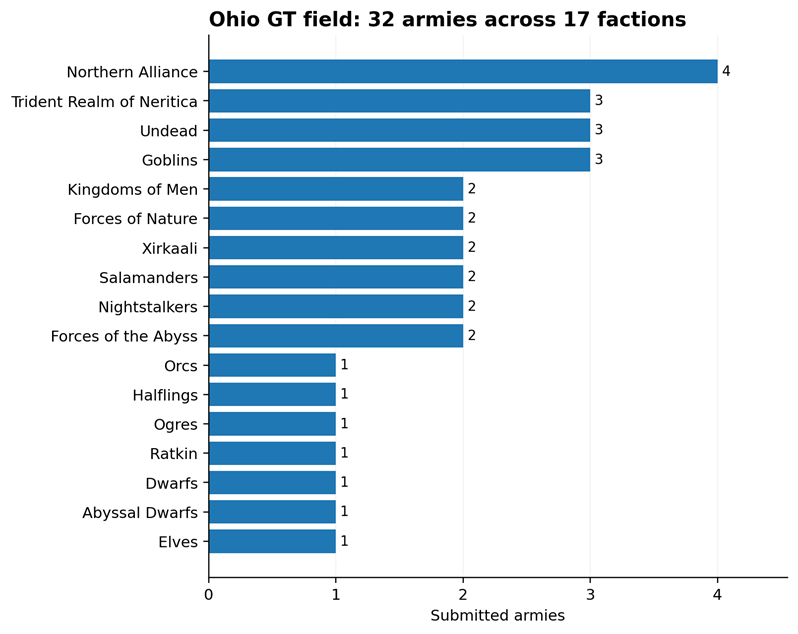
Seventeen factions in a 32-player event should create plenty of different pairings. But faction diversity and list diversity are separate questions. As I found in my earlier look at fourth-edition list repetition, the same unit can show up over and over inside a diverse faction field. Ohio gives us an unusually clear example.
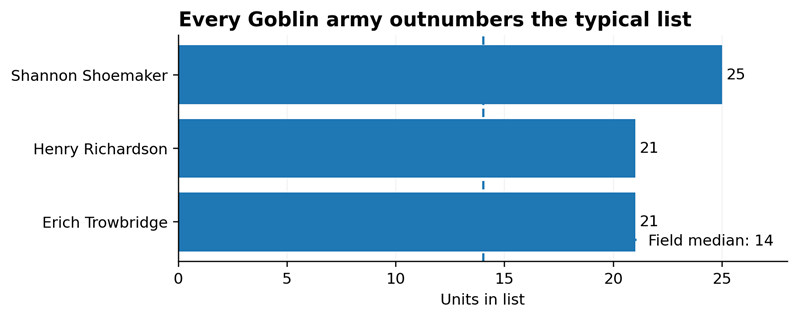
Shannon Shoemaker brings 14 Rabble, four Big Rocks Throwers, and four Wiz (in an army that my too-early machine learning model absolutely loves). That army has 25 units and 41 Unit Strength, both tops in this field. Henry Richardson has nine Rabble but trades the rock throwers for Mincer Mobs, Luggit Gangs, and more character support. Erich Trowbridge has only four Rabble; his 21 drops include four War-Trombones, three Mawbeast Packs, and two Goblin Blasters. Those are three different ways to ask the same question: can an opponent remove enough scoring pieces while still playing the scenario? At US Masters this summer, Ratkin and Goblins showed why that question deserves attention. Ohio will give us another test, not a guaranteed repeat.
Four Northern Alliance armies and no single template
Northern Alliance has the most entries, and its recent UK Clash of Kings results make this a natural faction to follow. The Ohio lists, though, do not all take the same route. Aaron Richardson has three Pack Hunters, two Hearthguard, and a ranged component. Darek Bienkowski takes two Frostfang Cavalry and two Tundra Wolves; his list leads the report’s calculated expected-damage measure at 95.7 (!). Nick Scibetta brings two Ice Queens, a broader unit mix, and the second-highest Heal measure in the field. Ryan McKalip takes five Human Tribesmen and leans into the grind with 29 Unit Strength. After the UK COK showing for Northern Alliance, it will be interesting to see if similar builds have similar success here.
The long threat range race
Both Xirkaali players sit near the top of the report’s damage-weighted charge-threat ranking. Michael Carter leads at 15.6 inches and has the highest average Speed in the field at 7.6. Sam Moore ranks third at 15.0 inches, but has 15 units to Carter’s 12 and a different set of threats, including Warrior Packs, Wildfangs, and mortars. That does not mean they will charge first or win their early fights. It does mean their opponents may have to deploy and move with those threat ranges in mind. For a player’s view of the faction, Sam Moore has also written about his road to Masters with Xirkaali.
Shooting meets stealth and speed
My heuristics label ten of the 32 armies as Gun Lines. Jeff Franz’s Abyssal Dwarfs lead with 90 listed ranged attacks; Rob Sautbine’s Kingdoms of Men have 70. Bryan Trahan, Erich Trowbridge, and Devlin Smith also have substantial shooting. I have been tracking the changing role of shooting in fourth edition, and this event has several lists worth watching closely.
On the other side, Alexander Danylko and Jon Carter bring 29 Stealthy units and 15 flying units between their Nightstalker lists. The question is whether a gun line can buy enough time and space before those armies start dictating angles and targets. I’m curious to see how this particular angle plays out, given just how bad Nightstalkers have been in early 4e.
What I want to check after the event
First, did the Goblin lists turn their extra units and Unit Strength into scenario points? Second, which Northern Alliance approach held up across different opponents? Third, did the long Xirkaali threat ranges and the specialist gun lines control games, or did opponents find ways to take that space back? Looking forward to seeing the results and then no doubt hearing the always-entertaining Cyle Pool debrief later on the podcast circuit.